The digital landscape of International Organizations presents a mixed picture in 2026. Almost all the 111 organizations in this study are present on Facebook, LinkedIn, Instagram, X and YouTube. More than half are also exploring Bluesky, Threads, and TikTok while a third is experimenting with WhatsApp and other broadcast channels.
Headlines
International organizations have their largest audiences on Facebook (173,000 median followers) while LinkedIn is catching up with 170,095 median followers, and X is relegated to third place with 131,372 median followers.
They have registered their biggest growth on Bluesky (20%), Instagram (18%) and TikTok (17%) while growth on X has literally flatlined.
For leaders of International Organizations X remains the channel where they have the most followers (14,580 median followers) slightly ahead of LinkedIn (11,141 median followers).
Growth on X has stalled for personal accounts (2%) compared to 26% on LinkedIn.
Three leaders have catapulted into the Top 10 list of the most followed leaders of International Organisations, namely OHCHR’s Volker Türk, @WFPChief Carl Skau – who took over from Cindy McCain in early 2026, @UNReliefChief Tom Fletcher. Their followers have grown more than tenfold on X.
Christine Lagarde, the President of the European Central Bank has become the most followed leader of an international organization ahead of UN Secretary General António Guterres. Guterres is due to leave office at the end of 2026 and Lagarde in 2027, and it is unlikely that their successors will have the same social media clout.
The leaders that have grown the most are those who tend to post engaging presenter-led videos regularly updating their followers.
In this study, we analyse the social-media activity of 111 international organizations and the personal accounts of their leaders on Bluesky, Facebook, Instagram, LinkedIn, Threads, TikTok, WhatsApp, X and YouTube. The study includes multilateral organizations, leading non-profit and non-governmental organizations, and their chief executives.
Data was captured on September 1, 2026, using Audiense.com for X and a manual count on Bluesky, Facebook, Instagram, LinkedIn, Threads, TikTok, WhatsApp and YouTube.
The Most Followed International Organizations and their Leaders
The World Health Organization (WHO) is by far the most followed organization, with 82 million followers and subscribers on all platforms combined. The WHO isthe single most dominant institutional brand and #1 on 6 of the 9 platforms (Facebook, Threads, Instagram, TikTok, WhatsApp, and Bluesky).
UNICEF is in second position with 64 million followers, ahead of the UN which leads on the other three platforms (X, LinkedIn, and YouTube) and clocks up an audience of 46 million followers and subscribers up 6%. The World Economic Forum and the UN Refugee Agency complete the Top 5 list with a total of 29 and 16 million followers respectively.
Six of the Top10 international organizations have seen their follower numbers plateau. Only the World Food Programme (WFP), the Office of the High Commissioner for Human Rights (OHCHR) and UNESCO have increased their audiences by 22% to 30%. The International Criminal Court (ICC) has notably doubled its followers from 2.2 to 4.6 million.
Christine Lagarde, the President of the European Central Bank has become the most followed leader of an international organization with 6.7 million followers across her personal channels. UN Secretary General António Guterres has moved into second place with 6.4 million followers ahead of Tedros Adhanom Ghebreyesus, the Director General of the World Health Organization (WHO) with 4.7 million followers on Facebook, Instagram, LinkedIn, and X combined. @UNICEFChief Catherine Russel who has doubled her followers is in 4th position ahead of Ngozi Okonjo-Iweala, the Director General of the World Trade Organization
Carl Skau the acting Executive Director of the World Food Programme (WFP), Volker Türk, the High Commissioner for Human Rights, and Tom Fletcher, the Head of UNOCHA have made their entry into the Top 10 list this year thanks to their exceptional growth mainly on X.
It will be interesting to see who will become the next UN Secretary General, the next head of the WHO and the next president of the European Central Bank. António Guterres, Tedros Adhanom Ghebreyesus and Christine Lagarde have amassed millions of followers and in turn raised the digital profile of their respective organizations during their tenure.
One thing is for sure their successors are unlikely to have such a strong social media footprint. Among the candidates to become UN Secretary General, Chile’s former President Michelle Bachelet has 1.4 million followers n her social media platforms. Ecuador’s María Fernanda Espinosa has 169,206 just ahead of Argentina’s Rafael Mariano Grossi, the Director General of the IAEA with 163,587 followers. Rebeca Grynspan, the UNCTAD Secretary-General on temporary leave has 71,735 followers.
Considering the above, to stay digitally on top it might have been better for their organizations to set up personal-institutional accounts which could then be transferred to each new office holder and grow over time.
Bluesky
Three quarters of the leading international organizations have set up a presence on Bluesky, but most of them are still small with a median average account size of 1,445 followers. The 27 personal accounts have a median average of only 404 followers per account.
The World Health Organization (WHO) and Human Rights Watch (HRW) have 175,000 and 121,000 followers respectively and seen a modest growth of 4% on the platform. The European Space Agency (ESA) has rocketed into third place, doubling its size from 50,000 to 103,000 followers year-on-year.
Amnesty International UK and the UN Environment Programme complete the Top 5 list with 30,000 and 21,000 followers respectively. The 104 institutional and personal accounts have grown by 21% over the past year.
Annalena Baerbock, the outgoing President of the 80th Session of the UN General Assembly leads the pack with her personal account which was archived after leaving her post as Germany’s Foreign Minister and has lost some followers as it has been dormant ever since. Her personal-institutional account https://bsky.app/profile/unpga.bsky.social has more than doubled in size but stands only at 1,488 followers.
For many organizations the engagement on Bluesky is not worth the effort, and it is not surprising that UNESCO, which was among the Top 10 with 30,000 followers in 2025, has deleted its account. Many organizations are still standing on the sidelines wondering whether they should engage on the burgeoning platform.
Facebook
Almost all international organizations have a presence on Facebook. The 110 institutional pages have a total of 166,062,306 followers compared to only four million for the 49 personal pages and profiles of their leaders. The median average stands at 173,000 followers for institutional pages and only 6,100 for personal accounts. The institutional pages have seen a median average growth of 6% while the personal accounts seem to stagnate.
The World Health Organization (WHO) and UNICEF lead the Facebook rankings with 36 and 29 million followers respectively. The WHO has continued to lose followers while UNICEF is stable. With 8.9 million followers the United Nations page has grown by 16% moving into third place ahead of the World Economic Forum with 8.8 million followers. The UN Refugee Agency (UNHCR) completes the Top 5 list with 4.9 million followers. The United Nations Population Fund (UNFPA) has seen one of the strongest growth rates more than tripling its follower numbers reaching 2.7 million.
Facebook does not necessarily come to mind as the platform of choice for executive communications, but 49 leaders of international organizations have either official pages or personal profiles on Facebook. The Director General of the World Health Organization, Tedros Adhanom Ghebreyesus leads the rankings by a mile with 1.5 million followers, up 7% compared to September 2025. There is a strong female presence in the Facebook leaders ranking: Ngozi Okonjo-Iweala, Director General of the World Trade Organization (WTO), Christine Lagarde, President of the European Central Bank and Dr. Sania Nishtar, CEO of Gavi, the Vaccine Alliance are in second, third, and fourth place with around 400,000 followers each. Another female leader, Kristalina Georgieva, Managing Director of the International Monetary Fund (IMF) closes the list of the Top 5 most followed international organizations leaders.
Instagram
The World Health Organization (WHO) is leading the Instagram rankings with 1.7 million followers, but UNICEF is slowly catching up with 11.2 million followers. For the second year in a row both organizations have seen their follower numbers drop by more than 1% which could indicate that they have reached their potential on the platform.
The United Nations, the World Economic Forum and Greenpeace complete the Top 5 list with 8.5, 5.2 and 4 million followers respectively. All 106 institutional accounts combined have 83,295,519 followers and a median average of 51,368 per account. The median growth of the accounts stands at 18%. The European Central Bank (ECB) has more than doubled their followers reaching 209,000 followers as of September 1, 2026. The International Criminal Court and the UN Youth Office have continued their growth streak growing by 50% and NATO has grown by 36% reaching 2.4 million followers.
The 61 personal accounts of international organizations leaders, up from 54 in 2025, have a combined following of 3.1 million and a median average of 5,330 per account with a double-digit growth of 13%.
Annalena Baerbock, the outgoing President of the 80th UN General Assembly leads the ranking ahead of UN Secretary General António Guterres with 718,000 and 692,000 followers respectively. European Central Bank chief Christine Lagarde, WHO Director General Tedros Adhanom Ghebreyesus, and Alain Berset the Secretary General of the Council of Europe complete the Top 5 list of the most followed leaders of international organizations.
During her tenure as Annalena Baerbock, the outgoing President of the UN General Assembly has tripled the followers on the institutional @UNPGA account, which was transferred to her successor, Khalilur Rahman in early September 2026. Several personal-institutional accounts including @Interpol_SG, @ExecutiveDirector_UNHabitat and @SecGenNATO Mark Rutte have doubled their followers which illustrates that these institutional accounts can be quite personal with each new office holder.
Rebeca Grynspan, candidate for UN Secretary-General and UNCTAD Secretary-General on temporary leave has tripled her follower numbers during her election campaign. Tom Fletcher the Under-Secretary-General for Humanitarian Affairs and Emergency Relief also doubled his community reaching 42,000 followers on Instagram.
Threads
Sixty-six international organizations maintain accounts on Threads, Meta’s text-based platform competing with X. All the institutional accounts have a combined audience of 12,918,150, a median average of 12,290 per account and a median growth of 7%.
The UN Youth Office has seen the strongest growth on the platform with 69% year-on-year. The European Central Bank (ECB), the IAEA, NATO and CERN have grown their following by a quarter. UNESCO on the other hand has mothballed its account which had 566,000 followers in September 2025.
Only 21 leaders of international organizations have personal accounts on the platform with a median average of only 702 but a 16% growth rate year-on-year. UN Secretary General António Guterres leads the rankings by a wide margin with 211,000 followers more than doubling his audience on Threads over the past year. WHO Director General Tedros Adhanom Ghebreyesus and European Central Bank President Christine Lagarde are in second and third position with around 50,000 followers each.
Threads is intimately linked to Instagram and followers on Instagram are automatically ported over to Threads. This means that even dormant and inactive accounts can have large followings without ever having posted a single post.
On average the followership on Threads represents 14% of their Instagram community. The UN Economic and Social Commission for Asia and the Pacific (ESCAP) Threads following is half the size of its Instagram community and António Guterres’ followers on Threads are a third of his Instagram followers.
LinkedIn
The 108 institutional LinkedIn pages have a combined audience of 90,776,033 and a median average of 170,095 per page. For the second year running the organizations have registered a solid median average growth of 15% while the 87 personal profiles continue to skyrocket with a median growth of 26%, the highest median growth on any platform.
The United Nations (UN) is in the top spot on LinkedIn with 6.8 million followers, slightly ahead of the World Health Organization (WHO) with 6.6 million followers. They are followed by UNICEF which has overtaken the World Economic Forum with more than 5.6 million followers each. The page of the United Nations Volunteers (UNV) is in fifth position with 3.3 million followers.
LinkedIn, “the world’s largest professional network” as it describes itself, is the perfect fit for leaders of international organizations and 87 have personal profiles, up from 80 a year ago. But not all of them are active.
Christine Lagarde, President of the European Central Bank (ECB), is by far the most followed leader with 3.1 million followers. UN Secretary General António Guterres, who joined LinkedIn at the end of March 2023, is second with 1.2 million followers. Winnie Byanyima, UNAIDS Executive Director, Dr Tedros Adhanom Ghebreyesus, Director General of the WHO and Kristalina Georgieva, IMF Managing Director complete the Top 5 list of the most followed leaders of international organizations on LinkedIn.
Diene Keita, the Executive Director of UNFPA and Masato Kanda, the President of the Asian Development Bank have quadrupled their followers reaching 30,000 and 41,000 followers respectively. Volker Türk, the UN High Commissioner for Human Rights, Tom Fletcher, the UN Humanitarian Chief and Rebeca Grynspan, candidate for UN Secretary-General and UNCTAD Secretary-General have all more than doubled their audience on LinkedIn over the past year reaching 67,000, 24,000 and 27,000 followers respectively.
Twenty-two executives are now part of the Top Voicesprogram, an invitation-only group of experts across the professional world who are being featured on the platform. It is no surprise therefore that all 10 leaders on the list above have the coveted Top Voices label.
Embarrassingly, 51 executives have still not created a custom URL for their LinkedIn profiles and kept the number combination at the end of their profile URLs such as Fatih Birol, the IEA Executive Director.
LinkedIn Newsletter
Publishing a regular newsletter is the best way to create a new touchpoint with your current followers and potentially reach new LinkedIn users. Forty-five organizations are publishing newsletters from the Asian Development Bank’s ADB update to the WTO – Weekly Newsletter. All the newsletters combined have a subscriber base of 21.4 million with a median average of 245,613 subscribers for each newsletter and growing at an average of 17%.
Newsletter subscribers tend to grow with the follower number of pages and it is therefore no surprise that the Fast Facts from the UN have 2.6 million subscribers followed by the WHO’s Health For All Newsletter with 2.4 million subscribers and the UNICEF Spotlight in third position with 1.6 million subscribers.
The Latest from UNCTAD has doubled its subscription over the past 12 months reaching 416,000 subscribers. Tom Fletcher, the UN Relief Chief is the only leader of an international organization who maintains a personal newsletter. His monthly Humanifesto has become a must-read for humanitarians and has doubled reaching 13,000 subscribers. On the other hand, the World Economic Forum’s 3 Economic Trends has seen its subscriber numbers decline by 28%.
TikTok
TikTok has established itself as a serious channel to broadcast vertical videos. Sixty-four international organisations and seven of their leaders have set up channels on the platform. The institutional channels have a combined total of 18,839,877.
The channel of the European Space Agency (ESA) and the UN Youth Office have both more than quadrupled their followers now reaching close to 600,000 followers and 43,000 respectively. Five other channels have doubled their following over the past year. The median average growth rate of all the institutional accounts stands at 17%.
So far only seven leaders have dared to create a channel on TikTok including Annalena Baerbock, the President of the 80th Session of the General Assembly (19,000 followers), Barham Salih, the High Commissioner for Refugees (14,900) and Tom Fletcher, the Under-Secretary-General for Humanitarian Affairs and Emergency Relief Coordinator.
“It is important to be there where the conversations are”, said Tom Fletcher in his first TikTok video posted in early November 2025 admitting that he launched the channel “against his better judgement and against the advice of everyone, including my kids.” Over the past 10 months he has garnered 2,867 followers and 19,200 likes on his videos from the world’s hotspots.
And finally, the World Economic Forum leads in terms of likes on their videos with 18.8 million and counting.
X
X (formerly known as Twitter) is still very much used by all 111 international organizations in this study. However, overall institutional growth is flat. With a median average of only +0.3%, X is the slowest-growing platform among international organizations.
The United Nations is leading the X rankings with 16.1 million followers ahead of the World Health Organization (WHO) with 12.6 million followers. UNICEF is in third place with 10.5 million followers. Almost all 10 leading accounts have more than 4 million followers with the IMF, UN Women and the World Food Programme almost doubling their audiences on the platform.
All 111 institutional X accounts have a combined following of 134,128,114 with a median average of 131,372 per account. The personal accounts of leaders of international organizations have a combined following of 34,218,944 and a median average of 14,580 and registered a modest median average growth of only 2%.
Seven of the ten most followed leaders have made massive gains in followers over the past 12 months. UN Secretary General António Guterres, almost doubled his followers and is leading the pack with 4.3 million followers ahead of European Central Bank President Christine Lagarde who more than tripled her followers over the past 12 months surpassing Ngozi Okonjo-Iweala, the Director General of the WTO who is in third place with 2.5 million followers.
OHCHR’s Volker Türk, WFP’s acting head Carl Skau (@WFPChief), UNICEF’s Catherine Russell (@UnicefChief), and UNOCHA’s Tom Fletcher (@UNReliefChief) have increased their followers more than tenfold and have each more than 2 million followers. All four accounts have highlighted the dire situation of civilians in Gaza and other humanitarian hotspots around the world, topics which have gained major media attention over the past year and are relentlessly defending the UN system and calling for increased funding.
It is interesting to note that 34 of the 110 personal accounts are ‘personal-institutional’ accounts such as the @UN_PGA which was one of the first, created in October 2012 under Vuk Jeremić, the 67th President of the UN General Assembly and has been transferred to the subsequent assembly presidents ever since.
YouTube
The United Nations leads the rankings on YouTube with 3.3 million subscribers more than twice as many as the European Space Agency (ESA) with 1.4 million subscribers. With just over a million subscribers the World Economic Forum is in third place of the most followed international organizations.
All organizations continue to grow on YouTube at a median rate of 7% annually. The channel of the UN Framework Convention on Climate Change (UNFCCC) has registered an outstanding growth of 54% year on year reaching 103,000 subscribers. The median average of subscribers for the 115 institutional and personal channels stands at 18,000.
Although only in 11th place in terms of subscribers, Greenpeace has the best average video views of 85,473 for each of their 1,188 videos on the platform. UNICEF averages 85,196 views on their 4,900 videos and boasts 417 million views in total. All the videos on the channels of international organizations combined have been viewed 3.2 billion times and counting.
Personal channels are essentially a non-factor here. The six personal channels have barely any meaningful subscriber counts. YouTube remains an institutional/broadcast channel.
Broadcast Channels
Meta rolled out broadcast channels on Instagram in February 2023, WhatsApp in June and Facebook in October of the same year.
Broadcast channels are one-to-many channels where users can only react with a pre-defined set of emojis and vote in polls but cannot comment or reply to the posts which is a safe way to communicate to large audiences without the negativity of other more ‘social’ media platforms.
A handful of international organizations have been invited to join and trial the new channels at launch with smashing success.
WhatsApp
Meta’s messaging platform WhatsApp continues to attract international organizations: 37 organizations have set up channels on WhatsApp up from 29 a year ago.
However, these organisations which were early adopters of the broadcast channel and promoted globally on the platform have seen their follower numbers tank. UNICEF has lost a quarter of their subscribers and UNHCR, the WHO and the WEF have lost a fifth each.
Only two leaders have personal broadcast channels, namely UNICEF Chief Catherine Russell and UN Spokesperson Stephane Dujarric with 1.9 million and 600,000 followers respectively.
Meta’s broadcast channels were initially reserved for organizations with more than a million followers on Facebook or Instagram but over the past year other organizations have joined the flock. The International Organization for Migration has quadrupled its followers reaching close to 37,000 followers which is less the result of its posts but a due to promotion in certain markets.
To make an impact on the platform it is essential to be featured on the suggested channel lists in the different markets or globally. INTERPOL for example was promoted in France and reached 16,000 subscribers from inception and has not grown much beyond its French audience since. The channel is not featured in other markets globally and therefore literally undiscoverable. Many of the newcomers struggle to reach the 1,000-subscriber mark without being promoted by Meta.
A level global playing field for these institutional channels will be key for broader adoption of WhatsApp channels among diplomatic communicators. Our own DigiTips channel is virtually undiscoverable, having reached only 4 followers since its inception in July 2024. Please give us a follow: https://whatsapp.com/channel/0029VaTbcWtGpLHWbl6GVq08.
Instagram Broadcast Channels
Ten International Organizations maintain broadcast channels on Instagram. The World Health Organization leads the pack with close to 94,000 followers on its Health and Science channel. The European Space Agency (ESA) is in second place with their Cosmic Connection and the World Economic Forum is in third place with both around 60,000 members each. Half of the ten channels have less than 2,000 members. All channels combined have 257,600 members and a median average of 10,200 per channel.
Facebook Broadcast Channels
Only two international organizations, namely the World Economic Forum and UNCTAD have broadcast channels on Facebook’s Messenger platform. The World Economic Forum has 18,000 members and UNCTAD has 2,000 members. Facebook does not currently offer a single, centralized public directory or global search tab to browse all broadcast channels across the entire platform.
In 2026 the use of social media channels for communications has become ubiquitous. Two decades after the emergence of social media no president, no prime minister, no government or foreign ministry can afford not to be active on at least one or more social media channels.media no president, no prime minister, no government or foreign ministry can afford not to be active on at least one or more social media channels.
Facebook and X are the most popular digital diplomacy networks among leaders: the heads of state and government in 161 countries have personal accounts on both platforms, representing 83% of all 193 UN member states. Eighty percent of world leaders have set up personal accounts on Instagram.
Slightly over half of all the heads of state and government of the 193 UN member states maintain personal profiles on YouTube, LinkedIn and even TikTok.
Newer additions to the digital diplomacy toolbox, Bluesky, Telegram, and WhatsApp have been adopted so far by the leaders and governments in around 50 countries, representing roughly a quarter of all UN member states. The niche networks such as Mastodon and Snapchat are only used by a handful of leaders.
Adoption of X is global with only four countries where the governments do not have accounts, namely Laos, North Korea, São Tomé and Príncipe and Turkmenistan. Six countries don’t have a Facebook presence, namely Afghanistan, Eritrea, Laos, Nicaragua, North Korea, and Turkmenistan.
Despite its radical rebrand from Twitter to X, Elon Musk’s social network is still the channel for real-time #DigitalDiplomacy. The 1,179 accounts listed in the digital atlas have a combined following of 818 million and a median of more than 44,000 followers per account.
However, world leaders have their biggest audiences on Meta’s channels namely Facebook with a median of 80,000 followers, Instagram with 29,000 followers and WhatsApp with 72,000 followers on average. The 451 channels on YouTube have a median of only 5,460 subscribers and it is even less for LinkedIn with only 3,585 followers on the personal profiles of leaders and their institutional pages.
Adoption of governmental social media communication is pervasive in Europe and in South America where all governments have accounts on Facebook, Instagram and X. European leaders also lead the adoption of LinkedIn and YouTube while all South American leaders have a presence on TikTok and all but one have embraced Threads. Despite initial security fears 39 out of the 45 European countries have set up accounts on TikTok, the vertical video network.
Indian Prime Minister Narendra Modi is the most followed world leader with 390 million followers combined on his personal and the institutional @PMOIndia accounts on Facebook, Instagram, LinkedIn, WhatsApp, X and YouTube combined. And he isn’t even on Telegram, Threads nor TikTok.
Most Followed World Leaders on Social Media 2026
US President Donald Trump ranks second with a combined following of 264 million on his personal account and the institutional @POTUS accounts on Facebook, Instagram, TikTok, X and YouTube. He is neither on LinkedIn, Telegram, Threads, nor WhatsApp preferring his personal social network Truth Social.
Pope Leo XIV is the third most followed leader with 62 million followers combined on his nine papal language accounts on X and the new @Pontifex Instagram account.
While the leaders of the most populous countries obviously rank prominently in the Top10 ranking, El Salvador’s Nayib Bukele is an outlier. The self-proclaimed “Philosopher King” of a country with a population of only 6.3 million has established himself as the Latin American digital leader clocking up 47 million followers across his channels.
The only woman among the 10 most followed world leaders is Droupadi Murmu, the President of India. Turkish President Recep Tayyip Erdoğan, Brazilian President Lula da Silva, French President Emmanuel Macron, Indonesian President Prabowo Subianto and Ukrainian President Volodymyr Zelenskyy complete the Top 10 list of the most followed world leaders on social media.
While all G7 leaders have active personal social media channels, it is noteworthy that only two of the G20 leaders do not have a personal presence on social media, namely Russia’s Vladimir Putin and China’s Xi Jinping.
Bluesky is the smallest network in this study by a wide margin. The 118 accounts of world leaders, governments and foreign ministries, up from 110 a year ago, count 1,201,607 followers between them, 0.15% of the audience the same institutions command on X, with a median of only 1,099 followers per account. Half of all accounts have fewer than a thousand followers. Yet the median account grew 22% over the past year.
It is also, overwhelmingly, a European network. Europe accounts for 72 of the 118 accounts and just over half of all followers, and the European Union’s own institutions alone hold 27% of Bluesky’s entire leader audience: Ursula von der Leyen (123,996 followers, +21%), the European Commission (95,469), High Representative Kaja Kallas (69,702, +27%), European Council President António Costa (18,339) and the Council itself (9,691). Nowhere else in this study does Brussels loom so large.
Brazil’s Luiz Inácio Lula da Silva is the most followed leader with 295,611 followers, a quarter of the network’s entire audience, though his account barely moved over the year (+1%). Canada’s Mark Carney follows with 197,773 (+22%) and von der Leyen with 123,996. Poland’s Prime Minister Donald Tusk (73,524), Mexico’s President Claudia Sheinbaum (21,165), António Costa, the Netherlands’ Rob Jetten (17,970 combined on his personal and institutional accounts), Austria’s President Alexander Van der Bellen (15,607), Australia’s Prime Minister Anthony Albanese, who nearly doubled his following to 10,604, and Ireland’s presidency (10,440) complete the Top 10. Between them, the three largest accounts hold half of everything on the platform.
Most Followed World Leaders on Bluesky 2026
Bluesky’s distinctive contribution to digital diplomacy is not its size but its approach to identity. Instead of a purchased checkmark, the platform lets an institution prove who it is by using its own web domain as its handle, and governments have taken to it: Ursula von der Leyen posts as @vonderleyen.ec.europa.eu, the Commission as @ec.europa.eu, Austria’s President as @bundespraesident.at, Ireland’s as @president.ie, the German Foreign Office as @diplo.de and its minister as @aussenminister.diplo.de, Finland’s government as @valtioneuvosto.fi and Norway’s foreign ministry as @mfa.norway.no. Of the 118 accounts, 31 are verified by domain and 33 carry the platform’s blue tick.
Foreign ministers are unusually prominent here. Kaja Kallas is the most followed with 69,702 followers, ahead of Poland’s Radosław Sikorski (20,090), Austria’s Beate Meinl-Reisinger (11,823), Canada’s Anita Anand (7,072) and France’s Jean-Noël Barrot (6,725, +24%). Denmark’s Lars Løkke Rasmussen, Germany’s Johann Wadephul, Australia’s Penny Wong, the United Kingdom’s Yvette Cooper and Spain’s José Manuel Albares complete a Top 10 drawn entirely from Europe and the Anglosphere. Germany’s Auswärtiges Amt, with 24,780 followers, is the most followed foreign ministry.
Most Followed Foreign Ministers on Bluesky 2026
What the platform lacks is everyone else. Bluesky is present in only 52 countries, and outside Europe, the Americas and Oceania it barely exists at all. Africa’s 14 accounts have 816 followers between them, a median of 30. Asia’s nine accounts total 671 followers, the largest being Pakistan’s Foreign Minister Ishaq Dar with 242. India, Russia, Türkiye, Israel and Indonesia have no presence whatsoever, and the entire United States government is represented by a single @USAGov account with 265 followers.
The pattern is unmistakable. Bluesky grew as a refuge from X, and the leaders who moved there are those who found the alternative uncomfortable: EU institutions, Nordic and Benelux governments, Canada, Australia, Ireland, Brazil and Mexico. No populist of the right has followed them, no Gulf monarchy, no Asian power. Three years after its opening to the public, Bluesky has become the diplomatic salon of one political tradition rather than a public square, and its 1.2 million followers are less an audience than a statement about where a government prefers to be seen.
Facebook is most popular among government leaders in the Global South
Facebook is the social network where world leaders have their biggest audiences with over half a billion – 540,992,308 followers combined on the 838 pages of heads of state and government and foreign ministers surveyed.
Facebook is most popular among governments in the Global South and especially Asia. The 180 Asian government and leaders’ pages total 208 million followers (38% of the total) with a median of 162,000 followers, double the global median. European leaders and governments have more pages (226) but only 89 million followers combined and a median of just 66,500. Africa fields the most pages of any continent (239). Growth is healthy overall: the median growth among all pages is +14.6% year-on-year according to the DigiTips ranking as of 1 May 2026.
The leaders of El Salvador, Egypt, Indonesia, Bangladesh, the Philippines and Ethiopia all rank among the 10 most followed Facebook pages of world leaders. Indian Prime Minister Narendra Modi is in the lead with some 70 million followers on his personal page @NarendraModi and the institutional @PMOIndia page..
Most Followed World Leaders on Facebook 2026
Trump’s Facebook comeback. Beyond his personal @DonaldTrump page with 41 million followers and a growth of +14%, the official @POTUS page rocketed from 271,000 to 11 million followers over the past 12 months which represents a growth rate of +3,959%, the biggest growth in the dataset.
El Salvador’s President Nayib Bukele places third. The Facebook page of the social media-savvy president has grown by 60% to over 13 million followers.
Most Followed EU Leaders on Facebook 2026Most Followed Latin American Leaders on Facebook 2026
India’s President Droupadi Murmu is the most followed female leader on Facebook with 6.5 million followers. Her @PresidentOfIndia page places 11th and narrowly miss the Top 10 list. Mexico’s Claudia Sheinbaum and Italy’s Giorgia Meloni are the other two leading female leaders with 5.9 and 4.3 million followers respectively on their Facebook pages.
Most Followed African Leaders on Facebook 2026Most Followed Arab Leaders on Facebook 2026Most Followed East Asian Leaders on Facebook 2026
G7 leaders are Facebook minnows.
Apart from Donald Trump the G7 leaders show poorly on Facebook. French President Emmanuel Macron is the most followed EU leader with 5.7 million, ahead of Italy’s Prime Minister Giorgia Meloni with 4.3 million and newly elected Hungarian Prime Minister Péter Magyar with 1.4 million. Canada’s Mark Carney almost quadrupled his followers up from 399,000 to 1.5 million. British Prime Minister Keir Starmer (637,000 followers), Japan’s Takaichi Sanae (170,000 followers), and German Chancellor Friedrich Merz (143,000 followers) have less than a million. Meanwhile China and Russia’s leaders are not on Facebook, but their ministries of foreign affairs are.
Personal beats institutional.
343 personal pages hold 335 million followers (62% of the total) versus 176 million followers across 472 institutional pages which seems to confirm that Facebook users prefer to follow leaders, not offices.
However, some foreign ministries have amassed quite large audiences namely the U.S. State Department, with a combined total of 4.3 million followers. The foreign offices of Egypt and India have more than 2 million followers respectively and the Philippines and Germany (which has a strong Spanish language page) register over a million followers.
Most Followed Foreign Ministers on Facebook 2026Most Followed Foreign Ministries on Facebook 2026
Foreign ministers are less popular on Facebook than the heads of state and government. The 116 personal pages of foreign ministers have a median of only 16,000 followers. U.S. Secretary of State Marco Rubio is the only one who has more than a million followers combined on his personal and his senatorial pages.
And finally, Pope Leo XIV has no personal Facebook page, however Vatican News has a global page with 11 million followers in multiple languages.
Instagram is the third biggest platform for world leaders with 481,169,294 followers combined on the 753 accounts of heads of state and government, foreign ministers and their institutions, up from 700 accounts a year ago.
The typical Instagram audience remains smaller than on Facebook, with a median of 29,108 followers per account against 80,000 on Facebook, but the picture network is growing faster, with a median follower growth of 17% year-on-year compared to 15% on Facebook. Eleven leaders keep private Instagram accounts, and 22 accounts are dormant or inactive.
Indian Prime Minister Narendra Modi is the first world leader to break the 100-million barrier on Instagram with almost 102 million followers on his personal @NarendraModi account (+8%). His Instagram audience is almost twice the size of his Facebook page.
Most Followed World Leaders on Instagram 2026
US President Donald Trump has a combined following of 63 million on his personal @realdonaldtrump account, which grew by a third to 44 million, and the institutional @POTUS account with 19 million. The @WhiteHouse account registered one of the strongest growth rates of any institution, up 43% to 12 million followers.
Instagram is Volodymyr Zelenskyy’s network of choice. With 16 million followers, the Ukrainian President is the third most followed leader on the platform, almost five times his Facebook audience.
Indonesia’s Prabowo Subianto (15 million) is the only leader in the Top 10 losing followers (-1%), ahead of Brazil’s Luiz Inácio Lula da Silva (14.6 million, +9%). Pope Leo XIV attracted 13.3 million followers on the new @Pontifex account within his first year in office, instantly making him the seventh most followed world leader, whereas he has no personal presence on Facebook.
El Salvador’s Nayib Bukele (11.9 million, +19%) and Türkiye’s Recep Tayyip Erdoğan (11.7 million) follow, ahead of Sheikh Mohammed bin Rashid Al Maktoum, the Prime Minister of the United Arab Emirates (9.1 million).
Most Followed EU Leaders on Instagram 2026
Argentina’s Javier Milei comes in eleventh spot, with 6,433,202 followers, fewer than 30,000 ahead of French President Emmanuel Macron (6,405,925).
European leaders may trail in absolute numbers, but they are posting the strongest growth on the platform. Emmanuel Macron remains the most followed EU leader, up 44% year-on-year, just ahead of Italy’s Giorgia Meloni who grew 59% to 6 million followers. German Chancellor Friedrich Merz reached 3.2 million followers combined on his personal account and the institutional @Bundeskanzler account (+57%). Spain’s Pedro Sánchez more than tripled his following to 1.6 million.
Many leaders have started collaborations with their friends and peers or their institutional accounts to reach a wider audience as the posts appear on up to five profiles. Italian Prime Minister Giorgia Meloni and her Indian counterpart Narendra Modi took the now historic ‘Melodi’ selfie during COP28 in 2023. Their most recent video collaboration in late May 2026 has generated more than 290 million views and 13 million interactions on Instagram alone and helped boost the Italian Prime Minister who is the most followed female leader on Instagram. According to Donald Trump, Giorgia Meloni begged him for a photo at the G7 Summit in Evian in June 2026, a claim she has categorically denied. The exchange deepened the rift between the two politicians.”
Most Followed East Asian Leaders on Instagram 2026Most Followed African Leaders on Instagram 2026
India’s President Droupadi Murmu, whose @PresidentOfIndia account grew 28% to 5.8 million followers is the second most followed female leader ahead of Mexico’s Claudia Sheinbaum (3.1 million, +32%), and Tanzania’s Samia Suluhu Hassan (3.1 million, +12%). Japan’s Prime Minister Takaichi Sanae completes the female Top 5 with 1.3 million followers on Instagram, almost eight times her Facebook audience.
Most Followed Latin American Leaders on Instagram 2026Most Followed Arab Leaders on Instagram 2026
Geographically, Instagram is the mirror image of Facebook. Asian leaders and governments dominate with 213 million followers on 172 accounts, 44% of the total. Europe fields the most accounts of any continent, 245, but they total only 105 million followers. Africa, which has the most pages on Facebook, is Instagram’s blind spot: its 162 accounts muster just 20 million followers combined with a median of 7,472. Latin American presidents, by contrast, have the largest typical audiences: with a median of more than 100,000 followers per account, South America tops all continents.
As on Facebook, personal accounts beat institutional ones: the 323 personal accounts hold 380 million followers, 79% of the total, compared with 87 million followers on the 408 institutional accounts.
Foreign ministers barely register on the picture network. The 102 personal accounts of foreign ministers have a median of only 6,689 followers. US Secretary of State Marco Rubio is the most followed foreign minister with 5.6 million followers combined across his personal (2.5 million), Secretary (2.1 million) and senatorial accounts. He more than tripled his following in a year, the strongest growth of any foreign minister, ahead of India’s Subrahmanyam Jaishankar with 3.5 million followers (+37%).
Most Followed Foreign Ministers on Instagram 2026Most Followed Foreign Ministries on Instagram 2026
LinkedIn is the network where nobody unfollows, and where hardly anybody posts. The 450 accounts and pages of world leaders, governments and foreign ministries count 36,971,353 followers combined, but the median account has just 3,597 followers, the second-smallest typical audience of any network in this study.
What LinkedIn audiences lack in size they make up in loyalty: the median account grew 17% year-on-year and only six accounts lost followers. Audiences on the professional network only move in one direction. Engagement is another matter: almost half of all accounts, 47%, are inactive or dormant, set up once and quietly abandoned.
LinkedIn is also the only network in this study where institutions out-perform the personal pages of politicians. The 253 institutional pages have a median of 5,214 followers against 2,264 for the leaders’ personal profiles, an inversion of the pattern on every other platform. LinkedIn is a network of press offices, ministries and civil services more than of leaders themselves.
Most Followed World Leaders on LinkedIn 2026
However, leaders who are active and engaging reap the benefits. Narendra Modi claims his fifth platform crown with 5.4 million followers (+15%), ahead of Sheikh Mohammed bin Rashid Al Maktoum, Prime Minister of the United Arab Emirates (3.5 million, +6%) and Emmanuel Macron, whose 3.1 million followers have all but stopped growing (+3%). Ursula von der Leyen (2 million, +18%) and UAE President Sheikh Mohamed bin Zayed Al Nahyan (1 million) complete the Top 5.
The story of the year, however, belongs to Mark Carney. The banker-turned-Prime Minister more than doubled his following (+157%) to become the first Canadian leader past the million mark, and it is hard to imagine a head of government more native to LinkedIn’s habitat.
The same logic lifts the platform’s other fast risers: German Chancellor Friedrich Merz (+56% to 347,000), Belgium’s Bart De Wever (+47%) and New Zealand’s Christopher Luxon (+42%) – the professional-class politicians thrive on the professional network.
Most Followed EU Leaders on LinkedIn 2026
LinkedIn itself has taken notice: at least 15 world leaders now carry the platform’s editorial ‘Top Voice’ badge, among them Modi, Macron, Giorgia Meloni, both UAE sheikhs, Carney, Keir Starmer, Merz, Anthony Albanese and Cyril Ramaphosa. No other network officially certifies heads of state as content creators.
Geographically, LinkedIn is the Brussels network. European accounts hold 16.8 million followers, 45% of the total, with a median of 7,796, more than double the global figure, and the EU institutions themselves rank among the biggest accounts, from the European Commission (2.5 million, +13%), to the Council of the European Union (459,000) and the Dutch Rijksoverheid (413,000), with the French and Italian government pages at around 200,000 each. The Government of Canada (1.1 million, +23%), the Prime Minister’s Office of the UAE (414,000) as well as the governments of Australia and Japan rank prominently in the Top 10 list of government pages.
Most Followed Governments on LinkedIn 2026
The absentees are just as telling. Donald Trump has no personal LinkedIn profile, leaving The White House page (107,000, +34%) to carry the American flag, and Volodymyr Zelenskyy, Claudia Sheinbaum and Javier Milei are absent too, while Nayib Bukele keeps a token profile with 3,340 followers. The whole of South America musters just 609,000 followers across 30 accounts. LinkedIn is hardly present in Africa where South African President Cyril Ramaphosa is in the lead with 350,000 followers. The Global South broadcasts elsewhere. LinkedIn remains the network of the professional West, the Gulf, and India.
Most Followed African Leaders on LinkedIn 2026
Among the foreign ministers on LinkedIn French Foreign Minister Jean-Noël Barrot stands out with 120,000 followers and a 48% growth year on year. Luxembourg’s former Prime Minister and now Foreign Minister Xavier Bettel is in second position with 114,000 followers.
Most Followed Foreign Ministers on LinkedIn 2026
Xavier Bettel as well as Canada’s Mark Carney and Austria’s Foreign Minister Beate Meinl-Reisinger are among a handful of leaders and ministers who have not yet created their custom URL. Their LinkedIn profile slugs still carry a letter-and-number combination after their names.
Foreign ministries do well on reflecting the size of their diplomatic network since most of their diplomats tend to follow the mothership. The page of the U.S. State Department aptly named DOScareers leads the pack (1.6 million, +9%) followed by the UK Foreign Office, the French Foreign Ministry, Canada’s Foreign Service and the European External Action Service.
Most Followed Foreign Ministries on LinkedIn 2026
The one non-Western power centre is the Gulf: the six accounts of the United Arab Emirates total 5.1 million followers, making it the second country on the platform behind only India.
It is interesting to note that the government in the Netherlands has created a showcase page for their Prime Minister Rob Jetten which is subordinated to the Ministry of General Affairs. The government of Panama has created showcase pages for the different ministries including the Ministry of Foreign Affairs and the Presidency which is a smart way to reflect the government structures on the platform.
Which World Leaders are losing followers on Telegram?
Telegram is the only network where leaders are losing followers. The 111 channels of world leaders, governments and foreign ministries in 49 countries count 5,466,183 subscribers combined, with a median of 8,905 subscribers per channel. But the median channel lost 3% of its audience over the past year and 58% of all channels ended the year smaller than they began it, a rate of attrition no other platform comes close to.
The explanation lies in what Telegram became. It is the war network, and the war’s audience is receding. Ukraine, Russia and Belarus alone account for 45% of every subscriber in this study. Ukraine has eight channels and 1.5 million subscribers, more than a quarter of the entire platform, and almost all of them are contracting: the Ukraine NOW government channel lost 15%, the Office of the President 12%, Team Zelensky 15%. Volodymyr Zelenskyy remains the most followed leader on the platform with 670,970 subscribers, but even he shed 5%. Four years after Telegram became the primary channel through which Ukrainians followed the invasion, the audience is turning away from this channel dominated by a Russian-speaking audience.
Most Followed World Leaders on Telegram 2026
Russia’s state channels, by contrast, are among the few still growing, if slowly: the Kremlin’s news channel added 7% to reach 288,568 subscribers, the Foreign Ministry 6% and the Government 0.3%. Six Russian channels hold 671,816 subscribers between them.
Beyond the war, Telegram is the platform of Central and Southeast Asian presidencies. Cambodia’s Hun Manet is the outlier of the year, growing 41% to 554,116 subscribers, the second most followed leader on the platform. Uzbekistan’s Shavkat Mirziyoyev (241,686, +16%), Belarus’s presidential pool (245,335, +8%) and Kazakhstan’s Aqorda (76,253, +21%) follow, with the Kazakh presidential broadcaster growing fastest of all at +146%. Ethiopia’s Abiy Ahmed (168,634, +9%) is the only African leader of scale, and Syria’s new presidency channel enters the ranking at 199,973 subscribers. India’s MyGov Newsdesk, meanwhile, lost a fifth of its subscribers, Recep Tayyip Erdoğan 16% and Brazil’s Canal do Lula 16%.
What is most revealing, however, is how Western governments use Telegram: not to reach their own citizens, but to reach other people’s. Western Europe fields just six channels with 49,618 subscribers in total. Emmanuel Macron, with 32,640, is the only Western leader with a meaningful presence, and three of France’s four channels are the Élysée, the foreign ministry’s Russian-language feed and his foreign minister. Germany’s only channel is its embassy in Moscow. The United States is represented by two channels alone, one broadcasting in Russian and one in Persian. Israel runs seven, in Hebrew, Russian, Persian, Arabic and English, its Persian-language channel almost doubling to 115,061 subscribers.
Most Followed Governments on Telegram 2026
On Telegram, in other words, Western foreign ministries are not doing public diplomacy but counter-programming: speaking past hostile governments to Russian and Persian-speaking audiences on the one platform those audiences use. It is the clearest example in this study of a network being used as an instrument of information warfare rather than as a channel for domestic communication.
It is also, unusually, an institutional platform: 76 of the 111 channels belong to governments, presidencies and ministries rather than to individual leaders, and only 33 are personal. Telegram’s format explains it. A channel is a broadcast feed with no comments, no likes and no algorithm, well suited to a press service issuing statements at speed and poorly suited to a politician seeking a following. That may also be why so few new leaders have joined: unlike every other network in this study, Telegram is not attracting a new generation of leaders to replace the audience it is losing.
Threads is the network world leaders forgot. Three years after its launch, only 245 accounts of heads of state and government, foreign ministers and their institutions are active on Meta’s microblogging platform, up from 210 a year ago and 191 in 2024. That is barely a third of the 753 leader accounts on Instagram, even though setting up a Threads profile requires little more than a tap from an existing Instagram account. Their combined following of 21 million, with a median of 11,462 followers per account, amounts to just 4% of the leaders’ half-billion-strong Instagram audience.
The maths of the platform is sobering: the median Threads account attracts just 13.5% of its owner’s Instagram audience. Leaders bring their verified handle, their content pipeline and their name recognition to the new platform, and six out of seven of their Instagram followers stay behind.
Brazil’s President Luiz Inácio Lula da Silva is the undisputed champion of Threads with 3.1 million followers (+10%), converting an above-average 22% of his Instagram audience. It is no accident: Brazil is Threads’ second-largest market with some 36 million users. El Salvador’s Nayib Bukele follows with 2.2 million and the strongest growth in the Top 10 (+46%), ahead of Ukraine’s Volodymyr Zelenskyy (2.1 million, +13%). Sheikh Mohammed bin Rashid Al Maktoum, Prime Minister of the United Arab Emirates (987,000), and Italy’s Giorgia Meloni the EU’s most followed leader (695,000, +35%) complete the Top 5 list.
Most Followed World Leaders on Threads 2026
More striking is who is not on the list: six of the ten most followed leaders on Instagram have no Threads presence at all. Narendra Modi, Donald Trump and the entire White House apparatus, Prabowo Subianto, Recep Tayyip Erdoğan, Pope Leo XIV and King Charles III are all absent, as are Emmanuel Macron, Javier Milei and India’s President Droupadi Murmu. The paradox is greatest for Modi: the most followed world leader on Instagram has never posted on Threads, even though India is the platform’s largest market with more than 50 million users.
Their absence is, in large part, of Meta’s own making. In February 2024, Meta announced that Instagram and Threads would no longer proactively recommend political content, which users had to actively opt in to see. For politicians, a network whose algorithm was designed to keep their content away from new audiences held little appeal, and Meta only reversed the policy in January 2025, conceding that its approach had been too blunt.
Most Followed EU Leaders on Threads 2026
Threads was effectively closed for political business during the exact window when world leaders were deciding whether to adopt it. Donald Trump is a case apart: the US President co-owns his own network, Truth Social, where he is contractually bound to post first, and was banned from Meta’s platforms between 2021 and 2023. For everyone else the calculus was simply unfavourable: X still holds the diplomatic and journalistic audience that leaders want for their text statements, while Threads offered a fraction of an audience they already had elsewhere, for a parallel content workload.
Most Followed Latin American Leaders on Threads 2026
The result is a platform of abandoned storefronts. 95 of the 245 accounts, or 39%, are dormant or inactive. Many leaders set up shop in the early days, posted a few times, and quietly walked away. And yet, no one is losing followers: the median account grew by 23% year-on-year, the strongest growth rate of any network in this study, and only a single account registered a decline. Threads followers accumulate whether leaders post or not.
Most Followed Foreign Ministers on Threads 2026
There are signs the calculus is changing. Threads reached 500 million monthly active users in June 2026 and overtook X in daily active users in late 2025, closing in on its rival’s estimated 550 million monthly users. Since political content returned to the recommendation algorithms, the early adopters are being rewarded: the European Commission (371,000, +83%) and Ursula von der Leyen (242,000, +114%) retain over 31% of their Instagram audiences on Threads, the best conversion rates of any Western institution, and the fastest-growing account in the entire dataset is the presidency of the Democratic Republic of Congo (+137%). Egypt’s presidency has even achieved the rarest feat: its Threads following is double its Instagram audience, the only major account where the newcomer beats the incumbent. For the holdouts, the network they forgot may soon be too big to ignore.
TikTok is the only major network on which the world’s most followed leader does not exist. Narendra Modi, who tops the rankings on Facebook, Instagram, LinkedIn, WhatsApp and X, has no TikTok account, for the simple reason that his own government banned the platform in June 2020 and has never lifted the ban. Six years on, the absence of India, and of China, still shapes the map of political TikTok.
What is left is smaller but far livelier than the numbers suggest. The 370 accounts of world leaders, governments and foreign ministries across 143 countries count 132,390,164 followers combined, less than a fifth of the following on X, with a median of 13,750 followers per account. But they have collected more than 1.9 billion likes, and the audience is growing faster than on almost any other platform: the median account gained 19% over the past year and only 13% of accounts lost followers, against 35% on X.
With Modi absent, Donald Trump tops the ranking, and on a platform he once tried to ban. His @realDonaldTrump account counts 16.4 million followers (+9%) and the campaign-style @TeamTrump account another 13.6 million, with a staggering 361 million likes, the most of any political account in this study. The White House adds 6.5 million followers.
Most Followed World Leaders on TikTok 2026
In January 2026, after four extensions of the divest-or-ban deadline, TikTok’s U.S. operations passed to the majority American-owned TikTok USDS Joint Venture, with Oracle, Silver Lake and MGX holding 45% and ByteDance retaining 19.9%. The platform Trump moved to outlaw in 2020 he now both governs and dominates.
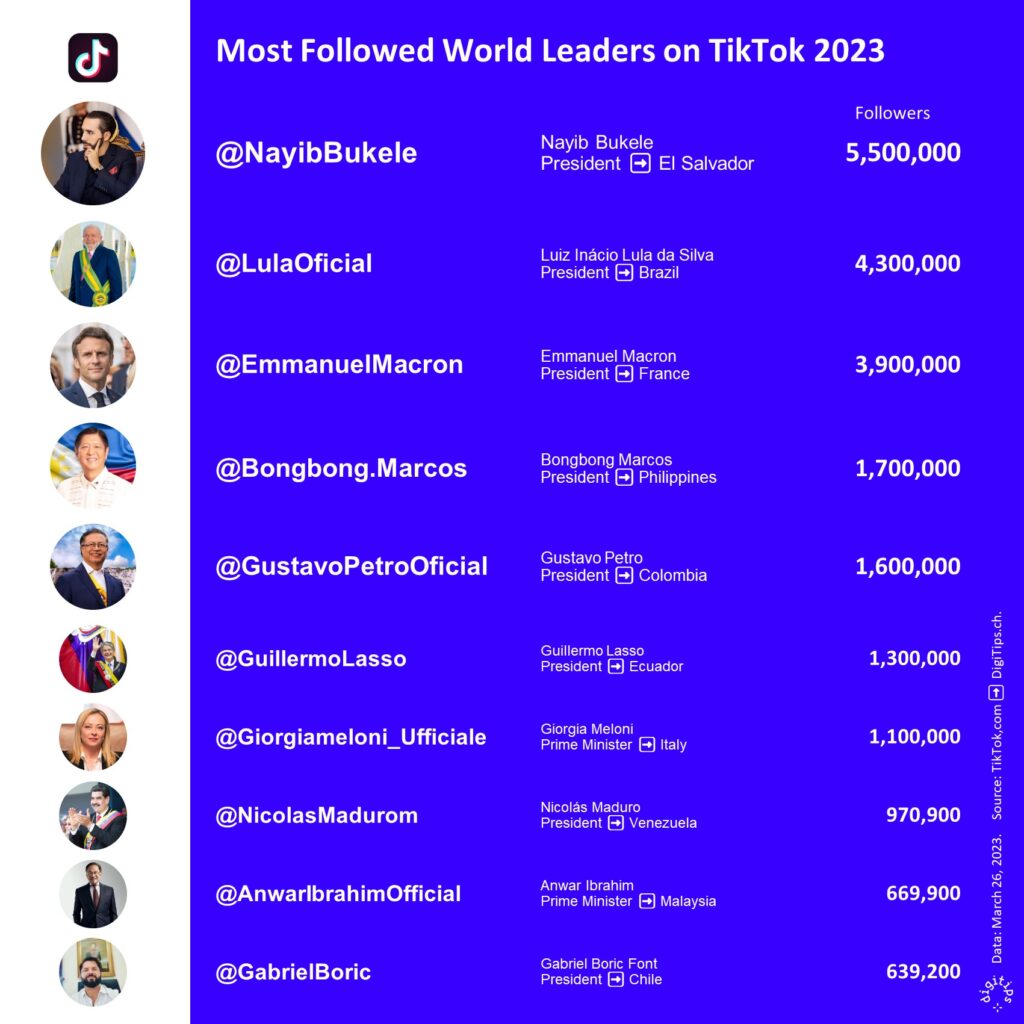
Behind him, TikTok is Latin America’s network. El Salvador’s Nayib Bukele is the most followed leader outside the United States with 11.7 million followers (+11%), Mexico’s Claudia Sheinbaum has 9 million and 158 million likes, making her the most followed female leader on any platform in this study, and Brazil’s Lula counts 5.4 million. Javier Milei (3.1 million), Ecuador’s Daniel Noboa (2.8 million) and Colombia’s Gustavo Petro (2.5 million, +25%) follow. South American accounts have by far the largest typical audience of any continent, with a median of 80,900 followers, six times the global median.
Most Followed Latin American Leaders on TikTok 2026
France’s Emmanuel Macron is the most followed EU leader with 7 million followers ahead of Italy’s Giorgia Meloni with 3.6 million followers after adding 50% in a year. Germany’s Friedrich Merz who has a personal channel and the institutional @Bundeskanzler account is in third place (931,900). Spain’s Pedro Sánchez (846,900) and Poland’s President Karol Nawrocki (624,800) complete the Top 5 list.
Most Followed EU Leaders on TikTok 2026
Africa and South America are the platform’s fastest-growing regions with a median growth of 24%. Africa’s 90 accounts across 38 countries hold 9.8 million followers, only 7% of the global total, with a median of 9,354 followers, below the global figure. But the continent’s combined following grew 54% over the past year.
Most Followed African Leaders on TikTok 2026
Kenya’s William Samoei Ruto leads with 1.8 million followers (+86%), ahead of Uganda’s Yoweri Museveni (914,800) and Ethiopia’s Prime Minister Abiy Ahmed, who almost doubled his following to 489,600. Rwanda’s Paul Kagame (245,400) and Zambia’s Hakainde Hichilema (229,700, +93%) complete the Top 5 List.
Institutions are catching up fastest of all: the presidency of the Democratic Republic of Congo (1.5 million, +36%) and Senegal’s presidency (916,400, +43%) are in the lead and the government of Côte d’Ivoire multiplied its following sevenfold to 225,500 and the South African Government more than sixfold to 140,800.
The absentees, however, are as instructive as the leaders. Beyond India and China, Egypt and the Vatican have no presence at all, Türkiye’s presidency has fewer than 200 followers, Saudi Arabia is effectively absent, and Russia is represented only by its foreign ministry with 19,400 followers.
Nor is having an account the same as using one. Of the 370 accounts in this study, 102, more than a quarter, have fewer than 1,000 followers, and ten have none at all: reserved handles registered by governments to stop anyone else taking the name, then left untouched. Ukraine offers the neatest illustration: the dormant @ZelenskyyUA handle sits at zero followers while the Team Zelensky account, run by his office, has 2 million.
On TikTok, followers matter less than views, and the like counts reveal who has mastered the format. Cambodia’s Hun Manet has collected 36 likes for every follower and Ecuador’s Daniel Noboa 30, followed by Hungary’s Péter Magyar (28) and Team Trump (27). Collectively, leaders’ accounts added 29% more likes over the past year, growing engagement faster than audience.
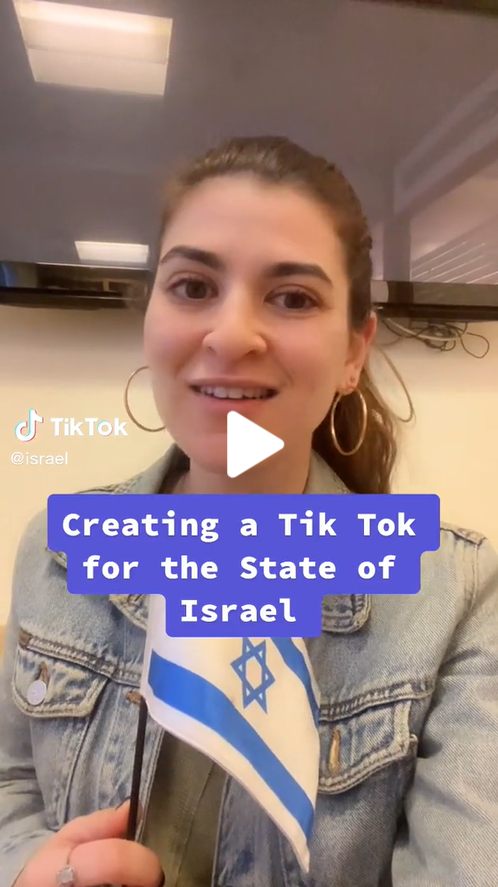
The most systematic operation on the platform belongs to Israel, whose foreign ministry runs a multilingual TikTok network: the English @Israel account (1.4 million, +27%), @IsraelinSpanish (949,800) and @IsraelArabic (247,900), for a combined 2.6 million followers across three languages, alongside Benjamin Netanyahu’s personal account, which doubled to 1.4 million. Ukraine’s foreign ministry (1.3 million) is the only other diplomatic service at that scale.
Elsewhere, the fastest growth comes from unexpected places. Armenia’s Nikol Pashinyan grew 262% to 362,000, Brazil’s @GovernodoBrasil more than tripled to 1.8 million and Peru’s presidency added 186%. Foreign ministers, by contrast, have yet to arrive. Only 40 have personal accounts, with a median of barely 2,000 followers, and Poland’s Radosław Sikorski leads them with a modest 65,900.
On WhatsApp Channels, Meta giveth and Meta taketh away. Two and a half years after their launch in September 2023, 78 channels of world leaders, governments and foreign ministries broadcast to 30,466,117 followers combined, up from 64 channels in 2025 and 35 in 2024. Thanks to WhatsApp’s enormous reach across the Global South, the median channel counts 72,107 followers, more than six times the median Threads account. But the platform has the weakest momentum of any network in this study: the median channel grew by just 1.5% over the past year, and almost half of all channels, 48%, are shedding followers.
One man towers over the platform: Narendra Modi’s channel counts 15.6 million followers, 51% of the entire WhatsApp following of world leaders, making WhatsApp the most concentrated network in this study. The Indian Prime Minister’s channel has ridden a rollercoaster that tells the story of the platform itself: promoted by Meta at launch, it peaked at 14.1 million followers in February 2024, lost 17% of its audience by May 2025 as the launch effect unwound, and then roared back with 35% growth to reach a new high this year.
Most Followed World Leaders on WhatsApp 2026
Most of the launch generation has not been as fortunate. When WhatsApp introduced Channels, Meta seeded the discovery directory and pushed a select group of official channels to its billions of users, inflating follower counts with people who tapped follow once and never looked back. Once the promotion stopped, the unfollowing began. The channels that already existed in early 2024 have shed followers at a median rate of 7% over the past year, with 56% of them in decline, while channels created later grew at a median of 6%.
The two-year toll on the early showcase channels is stark: Morocco’s government channel has lost almost half its audience since May 2024, falling from 600,000 to 310,000 followers, South Africa’s presidency is down 38% to 413,000, and Brazil’s flagship Governo do Brasil channel, once the second-largest in the world, has dropped 16% to 2.7 million. The decline is not limited to the early adopters: Claudia Sheinbaum’s channel lost 31% and Cyril Ramaphosa’s 34% in the past year alone.
Most Followed Governments on WhatsApp 2026
WhatsApp’s discovery directory surfaces popular channels country by country, and the newer arrivals are reaping the benefit. Spain’s Gobierno de España multiplied its following twelvefold to 283,000, Nigeria’s government channel grew 465% to 431,000, and Ivory Coast’s government added 57% to reach 423,000. Colombia’s Gustavo Petro, the most followed Latin American leader on the platform with 487,000 followers, grew 50% on top of quadrupling the year before, and the press office of Nayib Bukele added 67%. The UK government channel is up 40% to 389,000 and Germany’s Bundesregierung, which multiplied ninefold in 2025, has settled into steady growth at 742,000 followers.
Unlike every other network in this study, WhatsApp is a governments’ platform rather than a leaders’ one. Behind Modi, the biggest channels are institutional: Brazil’s Governo do Brasil (2.7 million), South Africa’s GovernmentZA (1.3 million), India’s MyGov (812,000) and the German Bundesregierung. Few heads of state broadcast in person: Mexico’s Claudia Sheinbaum (739,000), Tanzania’s Samia Suluhu Hassan (546,000), Cyril Ramaphosa (501,000) and Petro lead a short list. The format explains it: a WhatsApp channel is a one-way megaphone with no comments and no public metrics beyond emoji reactions, better suited to a government press office than to a politician in search of engagement.
X is still the undisputed heavyweight of digital diplomacy, but it has stopped growing. With 1,179 accounts of heads of state and government, foreign ministers and their institutions, and 818,004,134 followers combined, no other network comes close: X hosts more leader accounts than any platform and a bigger combined audience than Facebook (541 million) or Instagram (481 million), with a median of 44,369 followers per account. The platform that gave its name to Twiplomacy is standing still. The median account added just 1.6% over the past year, and 369 accounts, more than a third, lost followers, among the weakest momentum of the major networks in this study.
At the top, the crown is contested. Narendra Modi remains the most followed world leader on X with 165.1 million followers combined on his personal account and the institutional @PMOIndia (58.3 million, itself the third most followed account on the platform).
Most Followed World Leaders on X 2026
Donald Trump follows with 115.7 million combined on @realDonaldTrump and the institutional @POTUS account. The U.S. President can, however, claim one record: with 111.6 million followers (+7%), @realDonaldTrump is now the largest single leader account on any social network, having overtaken Modi’s personal handle which is, remarkably, the sole shrinking property in the Indian Prime Minister’s social media empire (-1%). Add the presidential Rashtrapati Bhavan account (28.1 million, the fourth most followed) and India’s top three accounts alone total 193 million followers.
Pope Leo XIV, whose @Pontifex accounts total 48 million across nine language editions, India’s President Droupadi Murmu (28.1 million) and Turkish President Recep Tayyip Erdoğan (23.5 million) complete the Top 5, ahead of Emmanuel Macron (10.5 million, +3%), Luiz Inácio Lula da Silva (10.2 million, +7%) and Sheikh Mohammed bin Rashid Al Maktoum (10 million). Gustavo Petro and Volodymyr Zelenskyy (both 8.4 million) and Nayib Bukele (7.9 million) follow.
African leaders are among the most followed on the platform but barely growing. Kenya’s William Ruto leads with 6.9 million followers, far ahead of Uganda’s Yoweri Museveni (3.7 million), Rwanda’s Paul Kagame (3.3 million) and South Africa’s Cyril Ramaphosa (3.2 million, +5%). Nigeria’s Bola Ahmed Tinubu completes the Top 5 and posts the strongest growth among the continent’s big accounts (+10% to 3 million), but the broader picture is stagnation: Ruto, Kagame and Ghana’s John Dramani Mahama all ended the year flat or marginally down.
Most Followed African Leaders on X 2026
The Arab leaders’ ranking is led by the Gulf royals, and they are the platform’s most conspicuous decliners. Sheikh Mohammed bin Rashid Al Maktoum (10 million, -11%) and King Salman of Saudi Arabia (9.7 million, -8%) and Jordan’s King Abdullah II (2.5 million, flat) all trail their 2025 numbers, while Egypt’s Abdel Fattah el-Sisi (6.3 million) and UAE President Mohamed bin Zayed (5.2 million) are treading water. Algeria’s Abdelmadjid Tebboune (+4% to 2.2 million) is the rare Arab leader in positive territory.
Most Followed Arab Leaders on X 2026
East Asian leaders are quietly backing away from X. Indonesia’s Prabowo Subianto remains the region’s most followed at 4.8 million but lost 6% of his audience, and Malaysia’s Anwar Ibrahim (1.9 million) and the Philippines’ Bongbong Marcos (1.3 million) also declined. The region’s momentum belongs to its newcomers: Japan’s Takaichi Sanae debuts at 2.9 million – X is by far her biggest network – South Korea’s Lee Jae Myung enters at 1.1 million, Cambodia’s Hun Manet more than doubled his following (+159%), and Singapore’s Lawrence Wong added 37%.
Most Followed East Asian Leaders on X 2026
Among EU leaders, Emmanuel Macron (10.5 million) remains in a league of his own: no other EU leader reaches a third of his following. Giorgia Meloni grew 13% to 3.3 million and Pedro Sánchez 24% to 2.5 million. At 1,712,312 followers (+6%) the EU Commission President Ursula von der Leyen is the fifth most followed EU leader. Five European leaders have personal and institutional accounts and are therefore among the Top 10 including Poland’s Donald Tusk (2.7 million, -4%), Dutch Prime Minister Rob Jetten (1.5 million), EU Council President Antonio Costa (1.2 million, -4%), Greece’s Kyriakos Mitsotakis (1.2 million, -3%) and Germany’s Friedrich Merz (750,000).
Most Followed EU Leaders on X 2026
Latin American leaders treat X as home turf: the region’s accounts have the largest typical audience of any continent, and its presidents the busiest keyboards. Lula (10.2 million, +7%) leads Gustavo Petro (8.4 million), Nayib Bukele (7.9 million) and Claudia Sheinbaum, whose +10% to 4.7 million is the strongest growth among the region’s presidents, ahead of the hyperactive Javier Milei (4.1 million).
Most Followed Latin American Leaders on X 2026
Beneath the surface, a very specific set of benches is thinning. The year’s decliner list reads like a geopolitical map: Erdoğan lost 10% of his following and the Turkish presidency 7%, Sheikh Mohammed bin Rashid shed 11%, as did UAE Foreign Minister Abdullah bin Zayed, King Salman lost 8%, the Kremlin 13% and the Russian Foreign Ministry 9%. Even the Holy See is not spared: the Pope’s Spanish and Italian accounts each lost 11%. The Gulf monarchies, Ankara, Moscow and the Vatican’s non-English audiences are all quietly draining from the platform.
And yet nothing demonstrates X’s enduring geopolitical weight like the accounts that surged. Iranian Foreign Minister Abbas Araghchi multiplied his following fivefold (+429%) to 853,000 in the wake of the June 2025 war, President Masoud Pezeshkian nearly tripled his, and Israel’s Persian-language account grew 25% in mirror image: when the missiles flew, the information war was fought on X. The other surge came from Washington: the @WhiteHouse account grew 163% to 4.5 million and @POTUS gained 31%, while Secretary of State Marco Rubio reached 7 million followers combined on his personal and @SecRubio accounts (+13%). Canada’s Mark Carney (+69%) completes the picture of a platform that still rewards those in the news.
Most Followed Foreign Ministers on X 2026
No platform is worked harder. El Salvador’s presidential press office posts 194 times a day, and Javier Milei, personally averaging 98 posts a day, is surely the most hyperactive head of state on Earth. Colombia’s presidency posts 41 times, and Gustavo Petro himself 27 times per day. For Latin America’s leaders in particular, X is less a channel than a firehose.
2025 has seen the emergence of bespoke accounts for real-time updates specifically designed for information warfare. The White House’s @RapidResponse47 rapid-rebuttal account fires 56 times a day to spread news about the activities of President Donald Trump. The French Foreign Ministry has set up its very own @FrenchResponse account in September 2025 which debunks fake and misleading news mainly from Russian but also U.S. influencers, including the White House under Donald Trump. The American account is a firehose, the French one a sniper and posting with a great deal of wit, still out-followed its own ministry’s English account.
Most Followed Foreign Ministries on X 2026
The oldest accounts in the study, Japan’s @japan and Malaysia’s Anwar Ibrahim, both joined Twitter in March 2007, and 111 accounts predate 2010. Yet leaders keep joining even in the Musk era, with 105 accounts created since 2023.
The platform’s verification chaos, meanwhile, is its own story: 38% of all the government accounts are not verified, 112 accounts are paying for the blue verification mark, while 608 carry the free official governmental grey badge.
The governments of Benin, El Salvador, Israel, Japan, Kuwait and the United States have taken out X’s premium subscription for organizations allowing them to have unlimited affiliate accounts for their ministries and embassies.
Geographically, Asia dominates with 334 million followers, 41% of the total, while Europe fields the most accounts (327) for 184 million. North America’s 168.7 million is almost entirely the Trump concentration, sitting atop a modest median of 19,000, and South American accounts have, once again, the largest typical audience of any continent with a median of 92,171 followers.
YouTube is the platform where world leaders have published the most and are watched the least. The 483 channels of heads of state and government, governments and foreign ministries count only 81,014,775 subscribers combined, with a median of 5,460 subscribers per channel, one of the smallest typical audiences of any major network in this study. Yet those channels have uploaded 803,417 videos and accumulated 28.4 billion views. Nowhere else do leaders produce so much for so few followers.
It is also the steadiest platform. The median channel gained 8% over the past year and only 7% of channels lost subscribers, one of the lowest attrition rates of any network in this study. Subscriptions on YouTube are a one-way ratchet: viewers may stop watching, but they rarely unsubscribe. That is visible in the activity data, where 105 channels, more than a fifth, have not posted a video in over a year.
No leader dominates any platform the way Narendra Modi dominates YouTube. His personal and institutional @PMOIndia channels count 32.3 million subscribers, 38% of all the subscribers in this study, and 8.8 billion views, 30% of the total, across 41,844 videos. Add the President of India (2.98 million), and MyGov India (1.11 million, +29%) and a single country accounts for more than 45% of the world’s leader subscribers on the platform.
Most Followed World Leaders on YouTube 2026
Donald Trump follows at a distance with 3.97 million subscribers, though his channel was flat over the year (+0.3%), while The White House grew 24% to 3.08 million. South Korea’s Lee Jae Myung (1.93 million), Brazil’s Lula (1.6 million), Mexico’s Claudia Sheinbaum (1.54 million, +22%), the British Monarchy (1.44 million) and Volodymyr Zelenskyy (1.37 million) complete the upper tier, alongside the Vatican’s main channel (1.16 million) and Mexico’s government (1.09 million).
The oddest entry in the Top 10 belongs to Nepal. Balendra Shah, the rapper and structural engineer who became Prime Minister in March 2026 at the age of 35 after his party’s landslide victory, brings a channel with 1.3 million subscribers and 97 million views from just 25 videos, an average of 3.9 million views each. Almost none of it is political: the world’s youngest serving head of government arrived in office with a rap channel, and it is the most watched-per-video leader channel on the platform.
Hungary’s new Prime Minister Péter Magyar leads with 399,000 subscribers and 151.8 million views, narrowly ahead of Emmanuel Macron (397,000, +6%) and Italy’s Giorgia Meloni (366,000, +23%).
Most Followed EU Leaders on YouTube 2026
Poland is the platform’s most crowded political market, with four channels above 100,000 subscribers: Prime Minister Donald Tusk (144,000), the Chancellery (110,000), the presidency’s Prezydent.pl (107,000, +90%) and President Karol Nawrocki (102,000). Hungary’s government channel, with 10,991 videos and 313 million views, is the most watched in Europe. The 96 channels of EU leaders, governments and foreign ministries count 4.2 million subscribers between them, less than a seventh of Modi’s two channels, with a median of just 4,040 subscribers.
Subscriber counts, in fact, tell only part of the story, because on YouTube the view is the currency and the two diverge sharply. Brazil’s Portal Brasil has just 275,000 subscribers but 4.6 billion views across 2,042 videos, an implausible 2.2 million views per video, and South Korea’s government channel reports 1.37 billion views from 1,082 videos. Numbers on that scale point to paid promotion rather than organic viewing: on YouTube, unlike anywhere else, governments can simply buy an audience, and several of the platform’s biggest view counts appear to have been bought.
At the other extreme lies the platform’s real character: the unwatched government archive. El Salvador’s presidential press secretariat has uploaded 30,588 videos, an average of 2,370 views each. Colombia’s presidency has posted 22,249 and Uruguay’s 20,018, averaging 1,456 views. Cambodia’s rapid-response unit has published 12,444 videos watched an average of 79 times, and the Prime Minister’s own channel 6,021 videos averaging 96 views. For dozens of governments, YouTube is not a broadcast channel at all but a public video registry: a place to deposit the footage of every ceremony and press conference, addressed to the record rather than to an audience.
Most Followed Foreign Ministries on YouTube 2026
The Holy See runs the most extensive multilingual operation on the platform, with ten channels totalling 2.9 million subscribers, led by the main Vatican channel (1.16 million), its Spanish edition (969,000), Italian (319,000) and, remarkably, Vietnamese (257,000). But the same archive logic applies at the margins: the Vatican’s Slovenian and Lithuanian channels have uploaded thousands of videos watched, on average, a couple of hundred times each.
Growth, where it happens, is institutional. El Salvador’s press secretariat multiplied its subscribers almost eightfold, the European Commission more than doubled to 469,000, Poland’s Prezydent.pl grew 90%, Indonesia’s Prabowo Subianto 57%, Japan’s Kantei 43% and India’s Ministry of External Affairs 38%. Even the Kremlin’s channel added 24%. Declines are so rare as to be notable: France’s Gouvernement (-2%), Javier Milei (-0.8%) and 10 Downing Street (-0.3%) are the only significant channels that shrank.
Geographically, Asia holds 48.8 million subscribers, 60% of the total, and 15.1 billion views, while Europe fields the most channels (161) for 12.9 million subscribers. Africa’s 98 channels, the second-largest contingent, muster just 2.8 million subscribers between them, less than a tenth of Modi’s single channel.
Several hundred governments, world leaders and international organisations have lost their verification as Twitter pulled the plug on legacy blue check marks on April 20, 2023. Some 420,000 legacy verified Twitter accounts were demoted on the platform including over 300 accounts of heads of state and government, foreign ministers, and their institutions as well as 40 leading international organizations and their leaders.
Among the leaders and institutions who lost their verification are Pope Francis (@Pontifex), German Chancellor @OlafScholz, Dutch Prime Minister @MarkRutte, the UK @CabinetOfficeUK, Pakistan’s Foreign Minister @BBhuttoZardari, ECB President Christine @Lagarde, NATO Secretary General @JensStoltenberg and international organisations such as the @_AfricanUnion, the @ArabLeague_GS, the @ICRC & @IFRC, the @WEF and @WWF to name but a few. Over the weekend some of these accounts were granted either grey badges, gold badges or blue badges indicating they had subscribed to Twitter Blue. However the overall sentiment was one of chaos in the new system.
Over the past weeks Twitter had converted the old blue check marks into grey check marks for selected governments, multilateral organizations, and officials. However, it seems many governments and important international organisations have been left out.
Among the 1,160 Twitter accounts of heads of state and government and foreign ministers we track at @DigiTips only 684 are verified and among these only 374 have been switched to the grey badge which is free of charge.
In total seven royal accounts, 40 presidential accounts, 106 governmental accounts, 136 foreign ministries and foreign ministers and 79 international organisations and their leaders lost their precious blue tick. And 470 accounts of world leaders are still not verified.
In a message to partners Twitter has offered free verification including five affiliate accounts, however it is unclear whether this offer has been extended to governments and international organizations.
The US State Department is so far the only foreign ministry which has opted for the affiliate verification system, verifying all its 377 embassies and ambassadors. El Salvador’s President Nayib Bukele is the first world leader to have created an affiliate verification.
Giving the difficulties to obtain verification over the past years, a handful of African leaders have recently subscribed to @TwitterBlue including the President of Congo, Denis Sassou-Nguesso, and Sylvie Baïpo-Temon, the foreign minister of the DRC.
There is a lot of confusion around the new verification system and which organizations can be verified. Governments and multilateral organisations can apply for the free grey badge, but it seems not everyone did so, or their applications haven’t been processed yet. It seems the grey badge does not come with the perks from a Twitter blue subscription such as longer tweets, longer videos and priority ranking in replies are not included.
Twitter verification is essential, especially for official governmental accounts to avoid impersonation and the spread of fake news.
After having angered key advertisers, antagonized media organisations and journalists Elon Musk is on a collision course with world leaders and international organisations who have relied on Twitter for more than a decade to reach their citizens.
Elon Musk does not seem to be afraid of any governments or leaders complaining. As he said on a recent interview with Fox TV: “I think people are a little concerned about complaining to me directly in case I tweet about it.”
So far world leaders have been mum about the changes on the platform and few have publicly mentioned him on Twitter with one notable exception: the Russian Foreign Ministry had some suggestions for the Twitter logo.
For lists of governmental accounts check out the DigiTips Twitter Lists. [The has been updated on April 23 to include the outcome of the Twitter cull]
The heads of state, governments and foreign ministers and ministries in 58 countries have an official presence on TikTok and quite a few are still active on TikTok despite a creeping public sector ban of the Chinese-owned platform in a growing number of Western capitals. The leaders of France, Ireland and Israel are still active on the popular social media platform which is also widely used for governmental communications in South America where almost all leaders have a channel on the platform.
Creeping Public Sector Ban
TikTok has been banned from government devices in Canada, the US, the UK, the European Union and a-growing list of European countries. The Czech government promptly deleted its TikTok channel @strakovka which had a respectable 14’800 followers and accumulated 69’600 likes on its 17 videos. Latvian Foreign Minister Edgars Rinkēvičs announced on Twitter that he had deleted his profile @EdgarsRinkevics which had 680 followers. “For security reasons, I have deleted my Tiktok account, @arlietas [the Foreign Ministry] prohibits the use of this application on smart devices that have ministry emails installed” he tweeted.
In Europe the app is slowly disappearing from government phones: the EU Commission deleted its account shortly after banning TikTok from the devices of its 32,000 permanent and contract employees. The TikTok channel of the @EuropeanCommission had never been active and had less than 50 followers.
Despite the ban, the @10DowningStreet channel set up under former Prime Minister Boris Johnson in May 2022 is still available and now boasts more than 280,000 followers. However Downing Street hasn’t been active since the end of July 2022 and the last video is a short clip with Larry, the Downing Street cat predicting an England win against Germany in the final of the Women’s Euro in 2022. Neither Liz Truss, nor Rishi Sunak have ever used the official TikTok account, and it is unclear whether it is still hosted on a governmental device and when and whether it will be deleted.
On the other hand, the TikTok account of theSecretary of State for Energy Security and Net Zero, Grant Shapps is active on the platform. In a reaction to the TikTok ban he posted a clip from the film The Wolf on Wall Street in which Leonard Di Caprio’s character claims: “You know, I am not leaving… I am not leaving.” Grant Shapps wrote in the caption: “I’ve never used TikTok on government devices and can hereby confirm I will NOT be leaving TikTok anytime soon!”
TikTok for Government Communications
In Paris and Dublin, where TikTok is part and parcel of both governments’ social media toolkit leaders are somewhat reluctant to impose a TikTok ban. The French government tweeted a statement from State Secretary for Europe, Laurence Boone that: “The crucial point in the #TikTok case is that European data must remain in Europe. The Irish and French data watchdogs are currently conducting an inquiry to ensure the platform is fully compliant with this rule.” In France TikTok was banned from work phones of civil servants along with other “recreational apps” such as Candy Crush and Netflix.
However, French President Emmanuel Macron continues to engage with his 3.9 million followers on the platform. The French government maintains an official account @GouvernementFR and a bespoke @Republique_gouv channel to fight delinquency and radicalisation. The Minister of the Economy, Bruno Le Maire and the Ministry of Education both have active channels on the platform. An outright TikTok ban would simply deprive the government of a powerful channel to reach a younger audience.
Irish President Michael Higgins was the first world leader to set up a TikTok channel on 29 July 2019. The @PresidentIRL channel is still active and recently shared a 10-minute excerpt from his St. Patrick Day’s address. In Dublin, where TikTok has its EU headquarters, the government @MerrionStreet, the Tánaiste (Foreign Minister) @MichealMartinTD and the Department of Further and Higher Education all have an active presence on the platform. The government’s most recent video is showing Taoiseach (Prime Minister) Leo Varadkar celebrating the Hindu festival of Holi. In his most recent video Foreign Minister Micheal Martin’s is reading an excerpt from the Gruffalo to encourage viewers to “squeeze in a read”.
TikTok worldwide
TikTok is widely popular among Latin American leaders and most presidents and governments have an official channel on the platform. El Salvador’s president Nayib Bukele has become the most followed world leader on TikTok. With his 5.5 million followers he is reaching a large Spanish speaking audience far beyond the 6.3 million population of his country. Showcasing his #GuerraContraPandillas (#FightAgainstGangs), his team has started to subtitle his videos in English for a global audience.
Top 10 List of the most followed heads of State and Government on TikTok (as of March 2023)
Brazil’s President Luiz Inácio Lula da Silva is in second place with 4.3 million followers and French President Emmanuel Macron is in third place of the most followed leaders on the platform. Four other Latin American presidents make the Top 10 list, namely Colombia’s Gustavo Petro, Ecuador’s Guillermo Lasso, Venezuela’s Nicolás Maduro and Chile’s Gabriel Boric.
Bong Bong Marcos the President of the Philippines is the only Asian leader and Italy’s Giorgia Meloni is the only woman in the Top 10 TikTok ranking. The Italian Prime Minister used TikTok effectively during her election campaign sharing videos and snippets from her campaign trail and she has 1.1 million followers after only a year on the platform.
TikTok Diplomacy
As of March 26, 2023, 40 heads of state and government had an active presence on the platform. However, there’s hardly any interaction between world leaders on TikTok which is mainly used to reach a national audience.
Only eight foreign ministries (Belarus, Colombia, Cuba, Israel, Mexico, Russia, Somalia, and Thailand) and six foreign ministers (Colombia, Ireland, Mexico, Panama, North Macedonia, and Togo) maintain TikTok channels, and few are active on the platform. The Israeli Foreign Ministry has made the best use of TikTok with three separate channels in Arabic, English, and Spanish totalling 609,000 followers and garnering 4.8 million likes.
Tamar Schwarzbard of the Israeli Foreign Ministry creating a TikTok
The Foreign Ministry has set up a dedicated team who produce videos about Israeli culture, customs, and cuisine, promoting Israel to foreign audiences. No other government has used TikTok to build bridges across borders and cultural divides as Israel has done. No other social media platform is as suited for two-way communications as TikTok. Beyond the comments and likes users can remix, reply and even duet – a TikTok video reply – helping spread the original content to their followers and beyond.
A full ban of TikTok would be counterproductive since governments would no longer be able to reach their key national audiences. If the public sector ban is purely for security concerns, governments and leaders would be well advised to use ‘burner phones’ for their social media activities, phones which are not connected to their internal networks or email servers. As there has been no indication that the Chinese government has ever used TikTok to spy on its international users, it seems the partial ban of TikTok is mainly driven by geopolitical considerations. TikTok is not only one of the most popular apps, but also the only major app which is not Made in the USA, which seems to be the main reason for a likely ban in the US. However, it will be difficult and even impossible for governments with a strong TikTok audience to endorse a ban of the app. As Sara Morrison put it in Vox: Is TikTok too big to ban?
Ukrainian President Volodymyr Zelenskyy addressed the virtual meeting of G7 leaders on the one-year anniversary of Russia’s attack against Ukraine pleading for continued support in the fight for his country.
Canada’s @JustinpjTrudeau – although an outspoken supporter of Ukraine, German @Bundeskanzler Olaf Scholz and most surprisingly – @POTUS@JoeBiden do not follow the Ukrainian President despite being unilaterally followed by Volodymyr Zelenskyy who has 17 million followers on the platform. Zelenskyy does not yet have any digital relation with Japanese Prime Minister @Fumio_Kishida who holds the G7 presidency. The two men are not yet mutually connected on Instagram.
On Facebook the Ukrainian President follows 36 other pages including @JustinPJTrudeau who hasn’t returned the favour yet. Good digital relations on social are a sign of respect and close cooperation. While Zelenskyy is consistenly mentioning other world leaders in tweets, he would be well advised to follow his peers on social media to show the close digital cooperation.
Germany has a new Foreign Minister. Annalena Baerbock is Germany’s first female foreign minister and she hit the road running with trips to Paris, Brussels, and Warsaw on the day of her nomination.
On social media she decided to start from a clean slate: archiving her personal Twitter account with 419,000 followers (@ABaerbockArchiv) and creating new @ABaerbock account for her new role as Foreign Minister. The new account is growing fast and already counts 80,000 followers barely a week after inception.
In line with digital diplomatic etiquette, she has made digital overtures, unilaterally following all G7 and many EU foreign ministers as well as the foreign ministers of Andorra, Australia, Israel and Norway on Twitter. In total she has extended a digital welcome to a group of 30 peers, mainly men with a few female foreign ministers.
Guess how many have reciprocated? So far only seven foreign ministers, namely the foreign ministers of Austria, Canada, Croatia, Czechia, Latvia, the Netherlands, and Slovenia have reciprocated. The UK Foreign Secretary @TrussLiz, Norway’s @AHuitfeldt, Andorra’s @MubachFont, Finland’s @Haavisto and Belgium’s @Sophie_Wilmes follow her archived account.
Her first overtures on Twitter were for U.S. Secretary of State Antony Blinken, Josep Borrell Fontelles, the EU High Representative for Foreign Affairs and French Foreign Minister Jean-Yves Le Drian. Surprisingly or unsurprisingly, these three men have not reciprocated, despite having met physically with Annalena Baerbock in her first days in office. To put it into diplospeak not following her on Twitter is like refusing to shake hands, a clear case of a diplomatic affront.
Josep Borrell and Jean-Yves Le Drian would be well advised to have a closer look at who they follow. There might not be much point in following the archived accounts of former @SecPompeo and the @WhiteHouse45 nor the former foreign ministers @KonoTaromp @PavloKlimkin and @SigmarGabriel. It pays to keep on top of your followers and those you follow.
It is unlikely that Antony Blinken will ever reciprocate and follow @ABaerbock. Not because he doesn’t like Annalena Baerbock or Germany, but because he doesn’t follow any other peer. While @SecBlinken and the @StateDept promised to “revitalize our ties with our allies and partners” in early 2020, neither account follows any other foreign minister, foreign ministry, and not a single world leader, nor ally or international partner.
Screenshot of U.S. Secretary of State declaring: “We will revitalize our ties with our allies and partners.“
Is Digital Diplomacy dead?
The State Department is the most followed foreign ministry with 6.2 million followers and over 200 world leaders and foreign ministriesfollow the @StateDept, but it does give all of them the cold shoulder or is it the middle finger? Not following friends and allies on social media is a digital diplomatic faux pas, considering that the State Department once followed some of its allies and foes and has unfollowed them under the Trump administration.
Top 10 Most Followed World Leaders on Twitter (Data: December 2021)
Over the past decade world leaders have build armies of followers on Twitter. Nine of the 10 most followed current world leaders have more than 10 million followers on Twitter but they are not connecting with their peers. President Joe Biden, Pope Francis, Recep Tayyip Erdoğan, the President of India, Prime Minister Imran Khan, Sheikh Mohammed, Queen Rania of Jordan and King Salman of Saudi Arabia don’t follow any other users Twitter user. The Indonesian President Joko Widodo follows one other leader, namely Narendra Modi and Modi in turn does follow a host of other leaders, and tellingly he doesn’t follow Joe Biden.
Whether it is digital sloppiness or diplomatic ignorance, it does spell the death knell of digital diplomacy as leaders are no longer interacting on social media as they once did.
For the record, Bulgaria’s new Foreign Minister Teodora Genchovska joined Twitter this week. So far she is only followed by her counterparts from Austria, Latvia, Romania and Slovenia and her account isn’t verified yet.