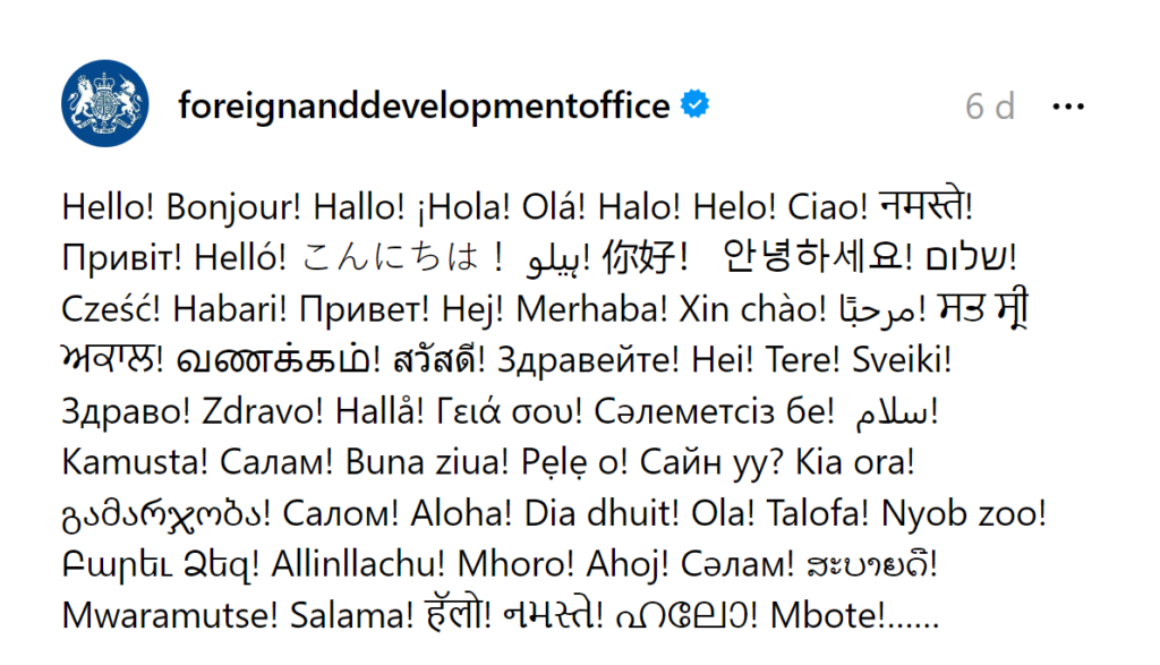
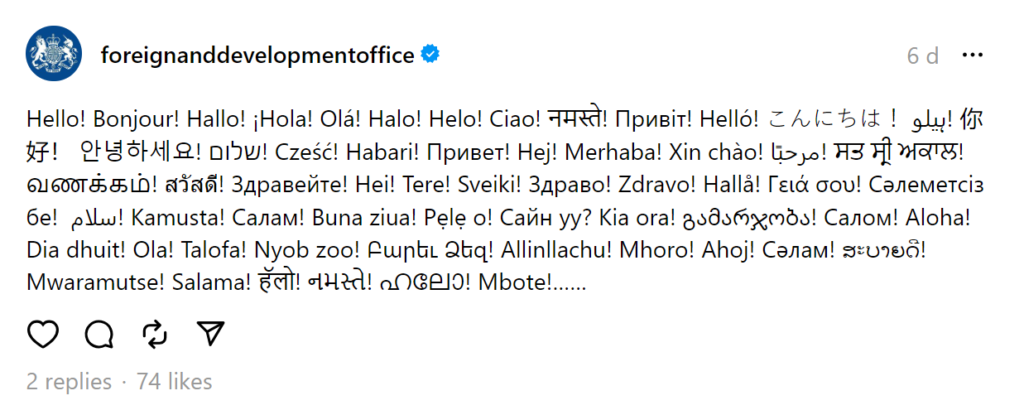
Two weeks ago, Meta’s new social network Threads was finally rolled out to users in the EU, almost six months after launching in the US. Within an hour of the midday launch the European Commission posted a “Hello Europe” in all 23 European languages. Italian Prime Minister Giorgia Meloni, Czech Prime Minister Petr Fiala and Belgium Prime Minister Alexander de Croo became the first EU leaders to post on Threads.
By the end of the day 16 accounts had set up shop on Threads. Two weeks since the introduction of Threads 33 EU leaders, governments and foreign ministries now have a presence on Threads but only half of them are active and have posted their first Thread. The uptake has been somewhat sluggish.
Among the 127 leaders who signed up in summer 2023 only 37 are somewhat active, the vast majority have either been dormant for weeks or haven’t posted anything yet. Some of the biggest world leaders on Instagram such as Indian Prime Minister Narendra Modi, Indonesia’s President Joko Widodo, and Ukraine’s Zelensky are still standing on the side lines. While the Princely Palace in Monaco and the Dutch Royal Household have activated their accounts, the British Royal Family isn’t present yet although fan accounts for the royals are proliferating on the platform.
Although many social media managers are unhappy with the changes on X, they are not ready to jump ship just yet. There are several reasons for the sluggish uptake of Threads:
🔵 Despite some users having large follower numbers – automatically imported from Instagram – the number of followers on Threads is only a fraction of their followers on Instagram. 🔵 Despite inspiring first threads, governments tend to share the same content on X and Threads. Some have even started posting screenshots of their posts on X. 🔵 Many social media teams are also waiting for Threads to become available on social media publishing tools such as Hootsuite or Sprout Social so that they can easily schedule their posts on the platform. 🔵 Most governments simply don’t have dedicated community managers to service a new social network, even if it only means cutting and pasting posts from X to Threads. 🔵 Most importantly, the engagement on Threads is far behind that on other platforms.
In a way Threads feels very much like Twitter in the early days, where users are trying to find and engage with new audiences. On the other hand, it also feels like Google+ where users had large artificial audiences but without any meaningful engagement.
Threads is unlikely to replace X for digital diplomacy anytime soon and it is more likely that both platforms will co-exist side by side.
It seems everyone is afraid of Elon Musk: corporations, governments, the media, and international organizations, no one wants to be in the cross hairs of his online wrath. Most world leaders are in awe of the most followed and probably the most influential person on X.
Few governments or international organizations have publicly reacted to the transformation of Twitter to X over the past year and the fundamental changes on the platform. When Elon Musk demoted all 420,000 legacy blue badge Twitter accounts, briefly depriving governments of vital verification, none of the 350 heads of state and government and international organisations complained publicly on the platform.
Musk is the most followed user on his own platform with 161 million followers and counting. To put this into perspective: he has twice as many followers as @POTUS and @JoeBiden combined. He has become an unelected leader presiding over a community of 260 million active daily users which would make it the fifth largest country in the world.
Elon Musk knows that he is untouchable. He has not had direct contacts with governments as he explained in an interview with Tucker Carlson. “I think people are a little concerned about complaining to me directly in case I tweet about it” he added.
World leaders are bending over backwards to please the richest man in the world in the hope that he might invest and build a Tesla car factory in their country. In 2023 he met with French President Emmanuel Macron, Indian Prime Minister Narendra Modi, Türkiye’s President Recep Tayyip Erdoğan and Israel’s Prime Minister Benjamin Netanyahu to name but a few. The discussions focused mainly on investment opportunities but not the management of his social media platform.
Elon Musk is currently followed by 32 heads of state and government including the presidents of Argentina, Chile, El Salvador, Hungary, Israel, Kazakhstan, Paraguay, Russia, and Serbia and the prime ministers of Canada, France, Moldova, Mongolia, Pakistan, Romania, and Thailand. He is also followed by 28 foreign ministers and 17 foreign ministries worldwide. Eleven international organisations including Human Rights Watch, UNESCO, the WTO, and the WWF are following him, as do 25 leaders of these international organisations.
Public interactions between Elon Musk and governments on the platform are rare. When Elon Musk questioned whether the German government was aware that German government-funded NGOs are helping refugees in the Mediterranean, the German Foreign Ministry replied laconically: “Yes, and it’s called saving lives.” German Foreign Minister Annalena Baerbock and her ministry have since diversified their social media presence opening accounts on Bluesky, a Twitter competitor.
The Belarusian Foreign Ministry on the other hand saluted Musk’s platform as “one of the last examples where free speech still exists”, proposing an online Space audio discussion to end the war in Ukraine. In April 2023 the Russian Foreign Ministry sent @ElonMusk suggestions for a new logo for the platform: a dog swallowing the blue bird with the message: “From the very heart bru.”
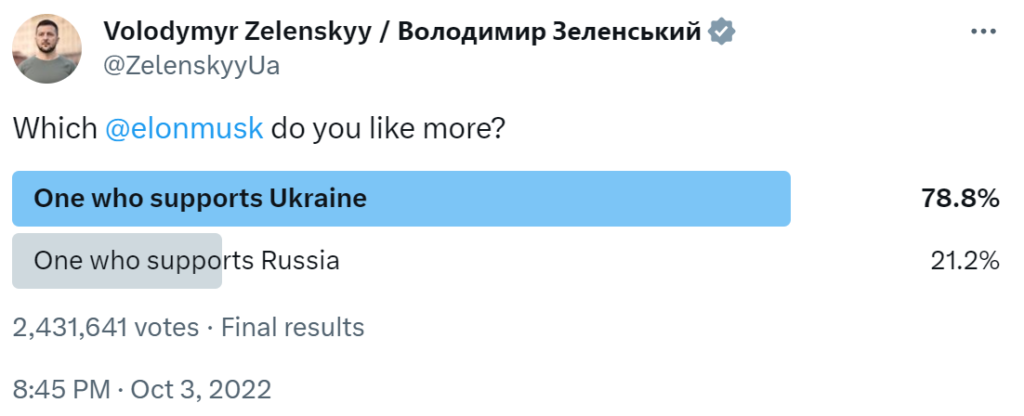
Ukrainian President Volodymyr Zelenskyy is definitely not afraid of Elon Musk. When Musk conducted a Twitter poll in October 2022 on whether “the will of the people who live in the Donbas & Crimea should decide whether they’re part of Russia or Ukraine”, the Ukrainian President conducted his own poll: “Which @ElonMusk do you like more? The one who supports Ukraine or the one who supports Russia?” The counter poll garnered 2.43 million votes and 78% favoured the one who supports Ukraine. Elon Musk replied: “I still very much support Ukraine, but am convinced that massive escalation of the war will cause great harm to Ukraine and possibly the world.”
The relationship between international organisations and Elon Musk seems to have soured since the sale of Twitter which sent shockwaves through the international community. In early November 2022 the UN High Commissioner for Human Rights Volker Türk issued an open letter reminding Elon Musk of the human rights responsibilities of companies to stop disinformation and ensure privacy and transparency and access to the platform’s data. “#FreeSpeech is not a free pass. Help us stop the viral spread of harmful disinformation, such as we saw during the Covid-19 pandemic in relation to vaccines. Don’t amplify content that results in harm to people’s rights.” the UN Human Rights organisation said.
Amnesty International posted publicly what many feared: “We at Amnesty International are incredibly concerned that within a week of taking control of Twitter, @elonmusk has laid off Twitter’s entire human rights team and AI ethics team.”
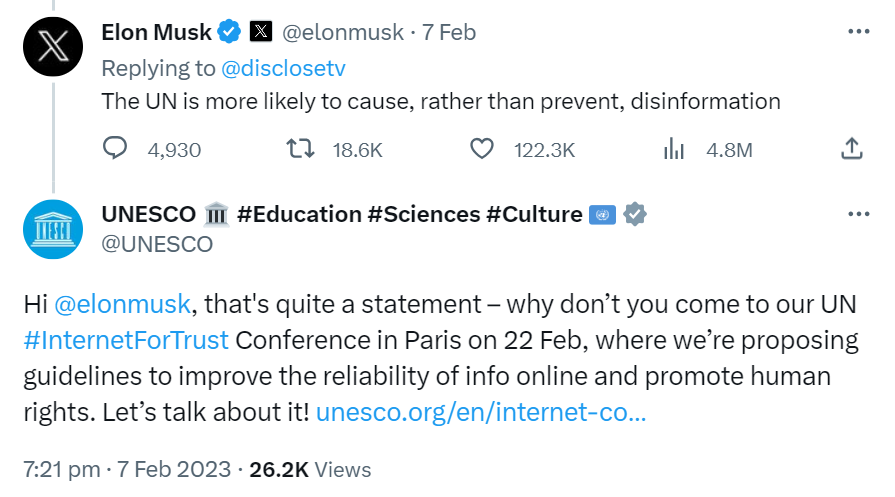
Elon Musk has repeatedly attacked the United Nations and UN agencies on his platform but few of these have reacted to his antics. In June 2023 he claimed without further proof that “The UN is more likely to cause, rather than prevent, disinformation”. UNESCO posted a rebuttal, inviting Musk to their #InternetForTrust Conference, an invitation he left unanswered.
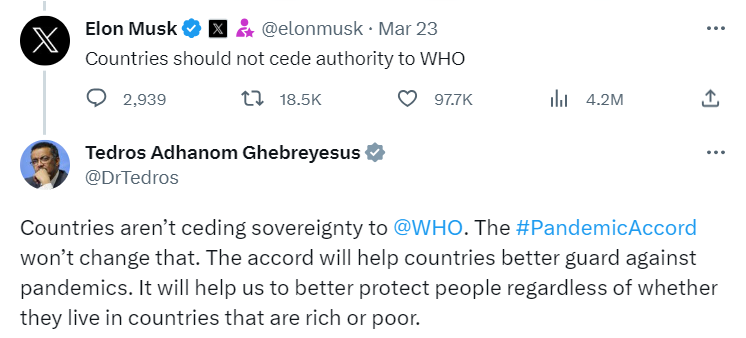
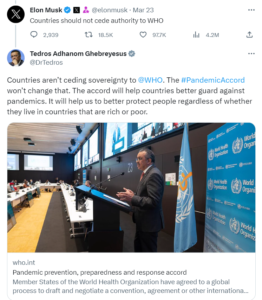
When Elon Musk stated in June 2023 that “Countries should make their own decisions and not rely on UN bodies like WHO”, the WHO Director-General Dr Tedros, corrected him a couple of hours later: “Countries aren’t ceding sovereignty to @WHO.”
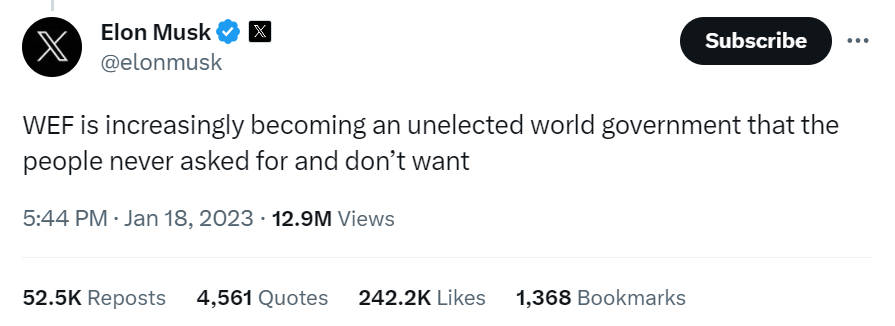
On the other hand, neither the World Economic Forum nor its chairperson Klaus Schwab replied to Elon Musk’s criticism that the “WEF is increasingly becoming an unelected world government that the people never asked for and don’t want”.
The common view among the diplomatic community is that you should not feed the trolls, and this includes the chief of trolls and owner of the platform who seems to always get the last word.
The past twelve months haven’t been easy for social-media managers worldwide. The rebranding of Twitter to X, the changes on the platform – from the loss of the blue badge, to paying for verification and Tweetdeck – have kept community managers on their toes to say the least.
There is a palpable uneasiness with the tone of the platform. While organizations are wary of the antics of its new owner Elon Musk, there hasn’t been any notable X-odus yet. However, it is fair to say that social-media teams are seeking alternatives. With every change on X, new platforms such as Bluesky, Mastodon and Threads have gained traction as organizations try to re-build their community and re-engage their audience on a different platform.
In this study, we analyse the social-media activity of 106 international organizations and the personal accounts of their leaders on Facebook, Instagram, LinkedIn, TikTok, X and YouTube as well as Bluesky, Mastodon, Snapchat and Threads. The study includes multilateral organizations, leading non-profit and non-governmental organizations, and their chief executives.
The Most Followed International Organizations
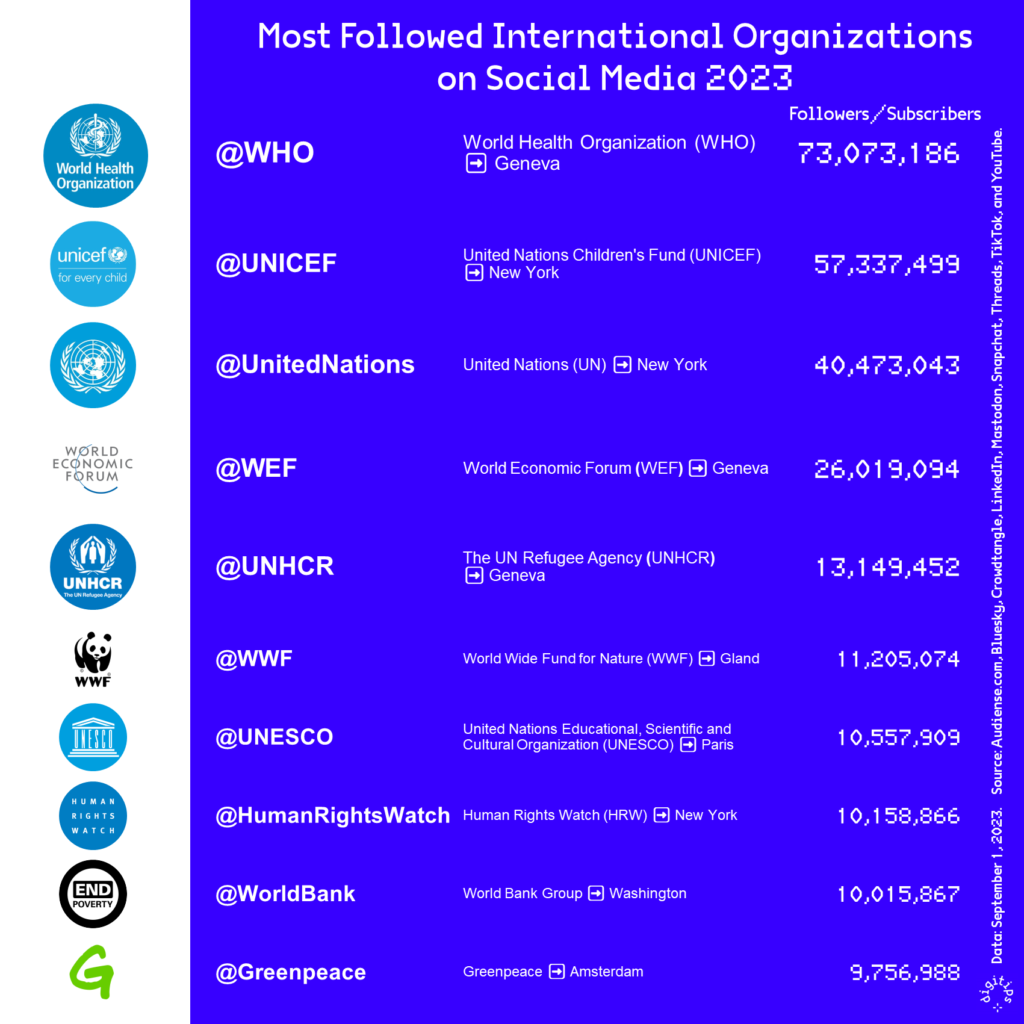
The 10 most followed organizations are in a league of their own. Almost all have more than 10 million followers across all platforms combined.
The World Health Organization (WHO) is by far the most followed organization, with 73 million followers and subscribers on all platforms combined. UNICEF is in second position with 57 million followers, followed by the main United Nations account which clocks up an audience of 40 million followers and subscribers. The World Economic Forum and the UN Refugee Agency complete the Top 5 list with 26 and 13 million followers respectively.
Given the potential size of the audience, Facebook is one the most important social networks for international organizations. The 102 institutional pages have a combined following of 150 million followers and the median average of followers per page stands at 330,000.
X remains the second most important network. The 106 institutional accounts have a combined following of 124 million, with a median average of 212,319 followers per account. LinkedIn is not far behind: 97 organizations have an official LinkedIn page and all pages combined have a total of 55.8 million followers and a median average of 194,415 followers per page. The combined total number of followers on Instagram is higher at 71.7 million, but the median average per account is only 75,789. All institutional and personal accounts combined have a combined following of 440 million on all networks.
The 10 Most Followed Leaders of International Organizations
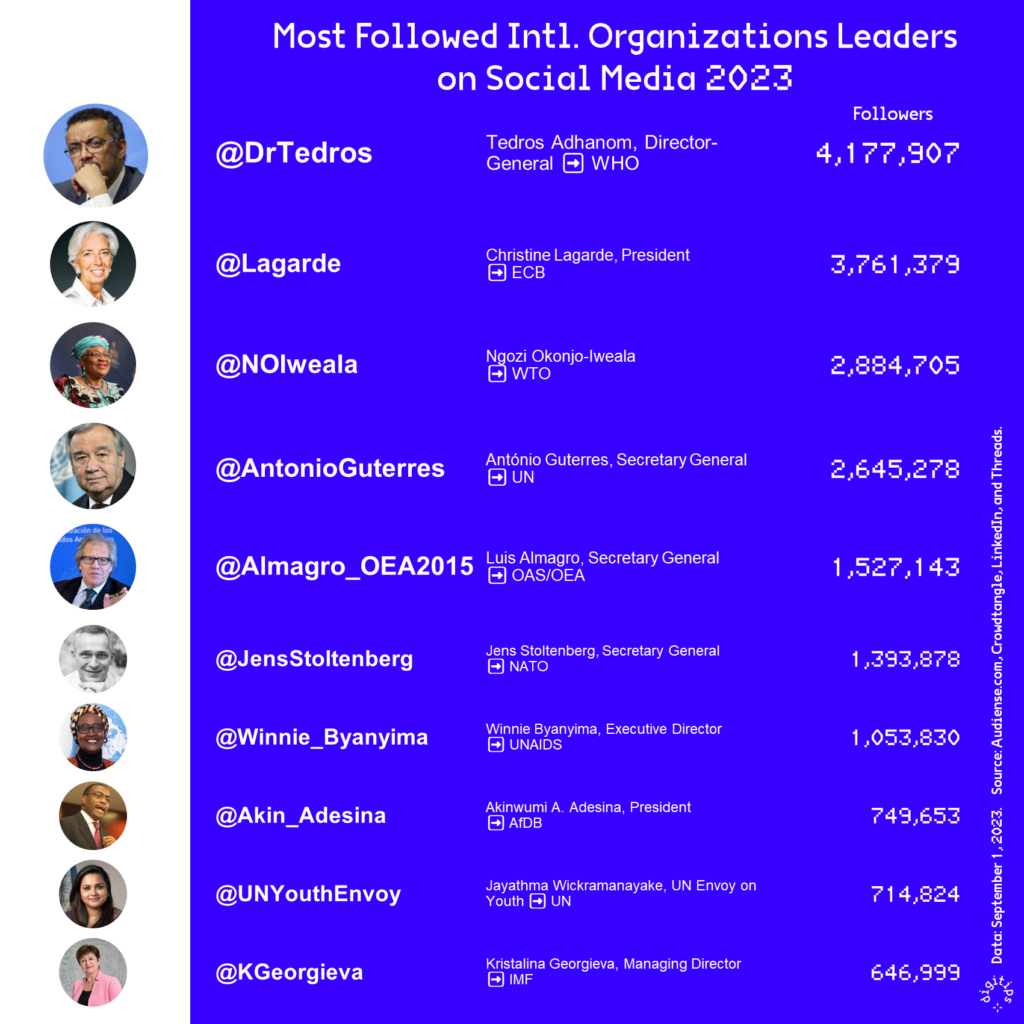
Dr Tedros Adhanom, the Director General of the World Health Organization (WHO), is the most followed leader of any international organization with 4.17 million followers on Facebook, Instagram, LinkedIn, and X combined. Christine Lagarde, the President of the European Central Bank is in second position with 3.76 million followers.
Ngozi Okonjo-Iweala, the Director General of the World Trade Organization and António Guterres, the UN Secretary General are in third and fourth position with 2.88 and 2.24 million followers respectively.
The outgoing UN Youth Envoy, Jayathma Wickramanayake is present on all social-media platforms and makes it into the Top 10 of the most followed leaders.
Data was captured on September 1, 2023, using Audiense.com for X and Crowdtangle.com for Facebook & Instagram with data going back 12 months; and a manual count on Bluesky, LinkedIn, Mastodon, Snapchat, Threads, TikTok and YouTube.
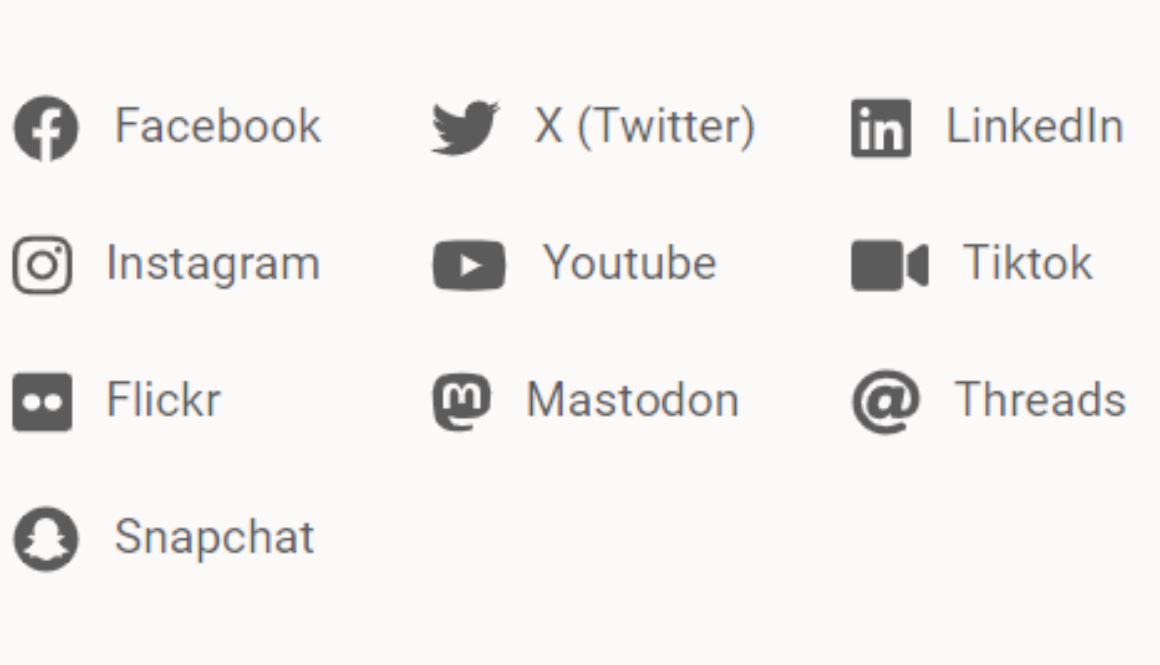
A month after the Twitter rebrand, only nine organizations had updated the social-media boilerplate on their websites, adding the new X logo. Interestingly, the Food and Agriculture Organization of the United Nations (FAO) is the only one which has put the social networks in alphabetical order. The World Economic Forum is the only organization to add he Threads logo to its social-media boilerplate.
Facebook
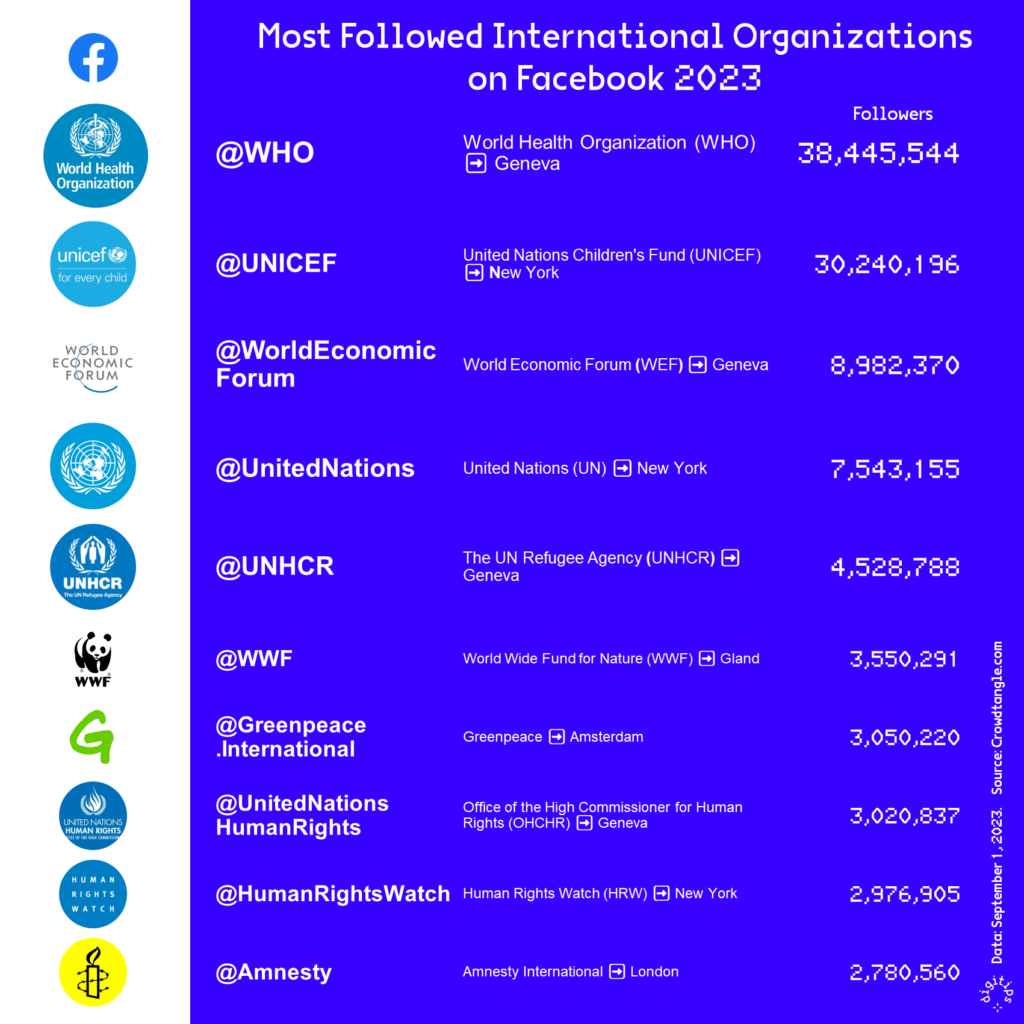
With the exception of the European Central Bank, almost all international organizations have a page on Facebook. All 102 pages combined have an audience of 150,683,211, a figure which has registered a modest growth of 1.73% over the past 12 months.
The World Health Organization (WHO) and UNICEF are topping the Facebook ranking, with more than 38 and 30 million followers respectively. The WHO was consistently boosted during the pandemic as reputable source on COVID-19.
The World Economic Forum (WEF), the United Nations and the UNHCR complete the Top 5 list of the most followed pages.
Interestingly, UNICEF, which often boosts its best performing posts, has clocked up more than 8 million interactions on their 1,329 posts, compared to only 2.4 million interactions on WHO’s 768 posts. Ove the past 12 months UNICEF has an interaction rate of 0.05%, compared to 0.02% for the WHO.
It pays to be consistently active on Facebook several times per day. The WEF posts on average 32 posts per day on Facebook, garnering 1.64 million interactions over the past 12 months.
UNICEF attracts the most likes and shares as well as love, sad and care reactions. The WHO, on the other hand, attracts the most comments, laughs and angry reactions which speaks volumes about their respective audiences and the amount of criticism the WHO is facing. The World Economic Forum leads in terms of total video posts and the number of wow reactions.
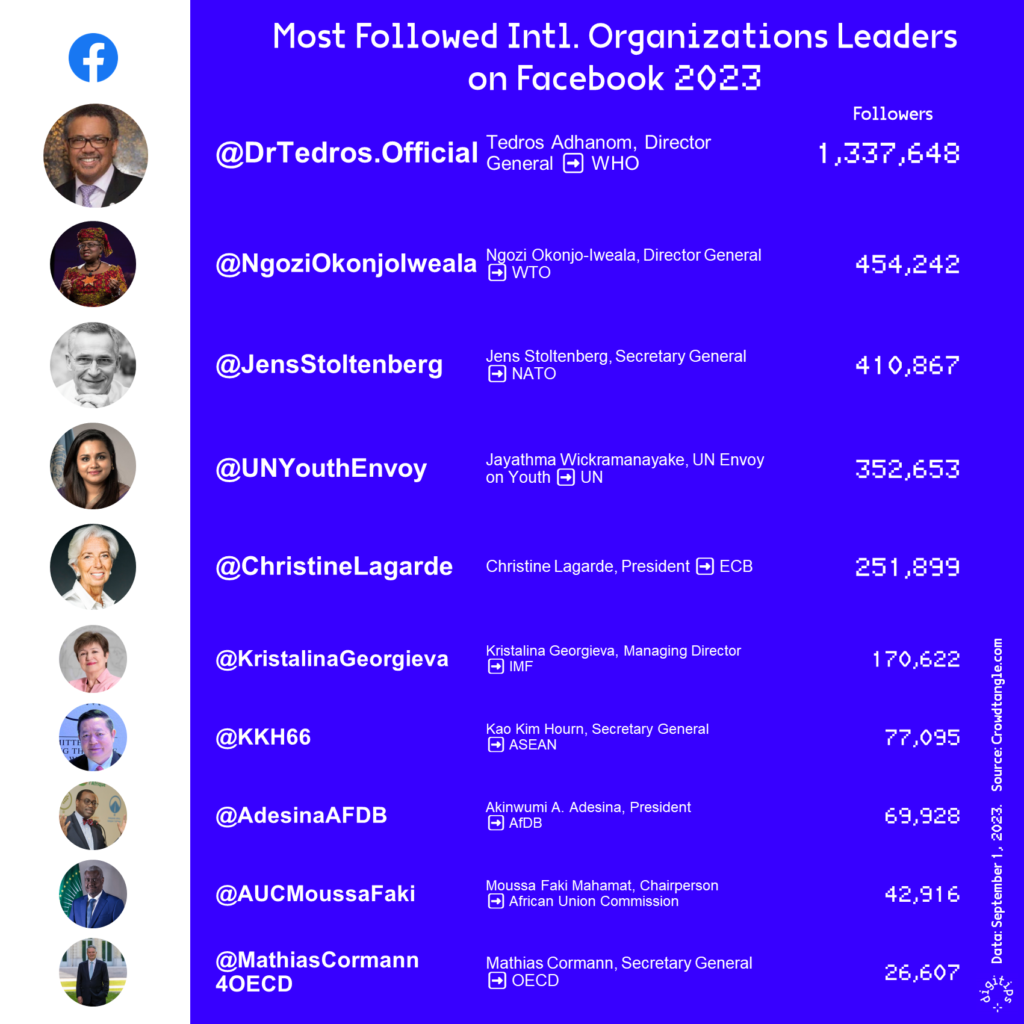
Facebook does not necessarily come to mind as the platform of choice for executive communications, but 24 leaders of international organizations have personal pages or profiles on Facebook.
WHO Director General, Dr Tedros Adhanom, leads the group with 1.31 million followers well ahead of the WTO’s Ngozi Okonjo-Iweala and NATO’s Jens Stoltenberg, each with more than 414,000 followers.
Dr Tedros followers represent 40% of the 3,287,195 followers of all 24 leaders combined. The median average number of followers of the 24 personal pages and profiles stands at just 12,174.
However, the interaction rate of personal pages often trumps that of the larger institutional pages, which goes to show how important personal engagement of executives on social media is. The UN Youth Envoy Jayathma Wickramanayake, the Secretary General of the Nordic Council Karen Ellemann and the United Nations High Commissioner for Refugees Filippo Grandi might only have between 12,000 to 15,000 followers and not be very active, but their interaction rate is well above 3%.
Among the institutional pages, UNESCAP, NATO and WIPO have the best interaction rates of between 0.30% and 0.25%. The median average of followers of the 101 institutional pages is 330,148, which makes Facebook the prime social media-platform given the size of the community.
In terms of post interactions, photo posts tend to perform best followed by videos, link posts and text-only status updates.
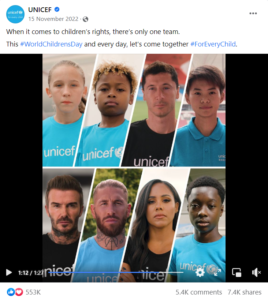
“When it comes to children’s rights, there’s only one team” The one-minute video posted by UNICEF ahead of World Children’s Day 2022, which also coincided with the start of the 2022 Football World Cup in Qatar, has become one of the most successful Facebook posts from any international organization in the past 12 months. This post performed well because it was cross-posted on other UNICEF national pages –more effective than simply sharing the post.
A fifth of the surveyed Facebook pages have “cross-posted videos” which helps amplify videos natively through other pages. Setting up a cross-posting relationship with another page is a cumbersome process, but is very effective for amplifying videos on Facebook.
Instagram
Instagram has become one of the prime audiovisual platforms. The platform combines three distinct channels: the main feed where pictures and videos are displayed in the traditional square format, the reels feed where videos are displayed in vertical format, and the stories feed with full vertical pictures or videos. It is important to choose the cover picture wisely when sharing a reel (video) on the main feed.
While the audience of all Facebook pages of international organizations have witnessed only a modest growth of 1.73%, their Instagram audience has increased by 6.72% year-on-year.
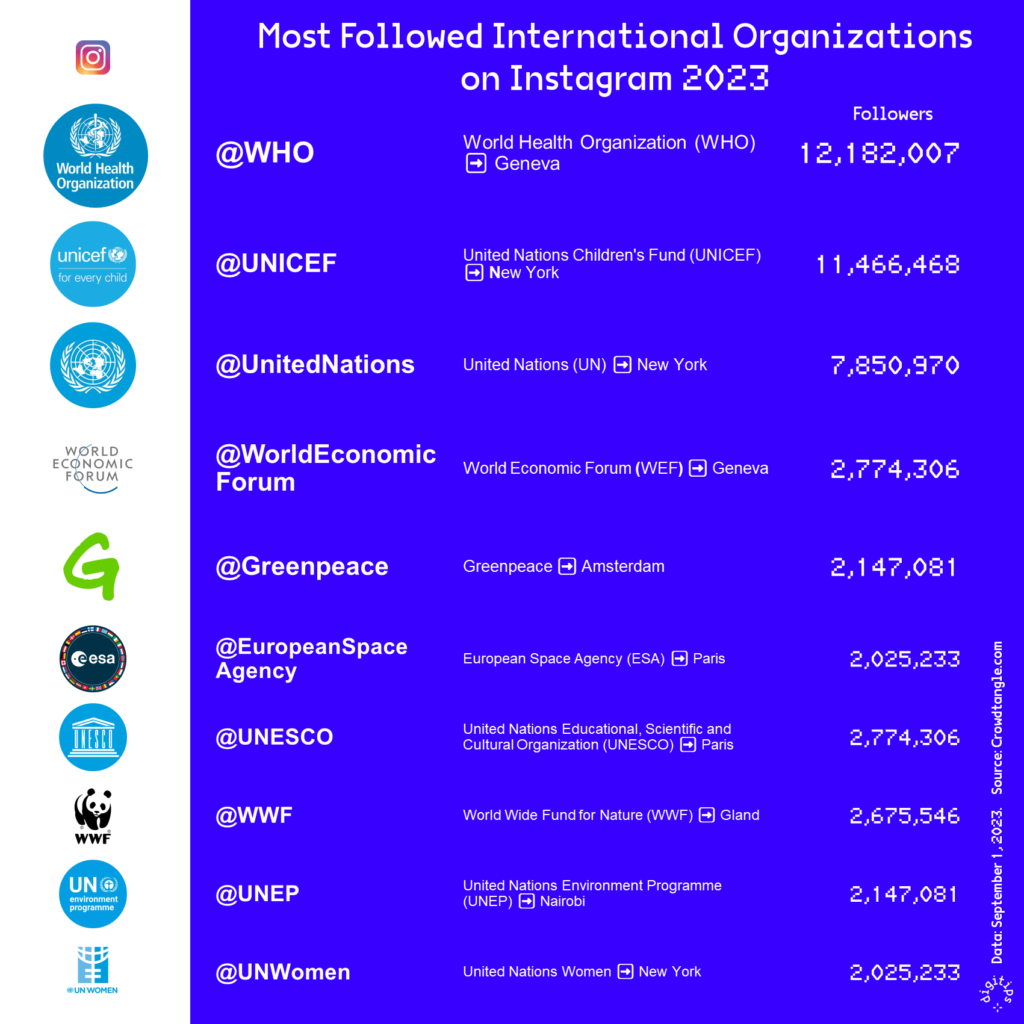
The World Health Organization (WHO) and UNICEF are crushing it on Instagram, with 12 and 11 million followers respectively. The United Nations, the World Economic Forum (WEF) and Greenpeace complete the Top 5 list of the most followed accounts, with 7.8, 4.7 and 4 million followers respectively.
In terms of interactions (comments and likes) UNICEF is once again leading the ranking, with close to 10 million interactions over the past 12 months. The United Nations is in second position, followed closely by the European Space Agency (ESA) with 8.8 and 8.7 million interactions respectively . The World Economic Forum (WEF) and NATO have garnered more than 6.3 million interactions over the past 12 months.
The WEF is killing it with its videos shared on Instagram. The videos, often posted as part of an album for maximum interaction, have generated 108 million views over the past 12 months. To put this in context, this is 1’ times as many views as the second runner-up, the European Space Agency (ESA) with 11.18 million views.
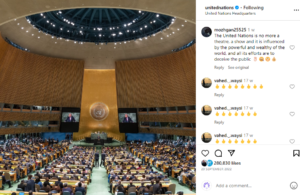
The picture of the UN General Assembly shared by the UN on the opening day of the 77th session has become the Instagram post with the most interactions by any international organization over the past 12 months. The post has amassed 1,23 interactions, including 285,111 likes and 947,648 (often negative) comments.
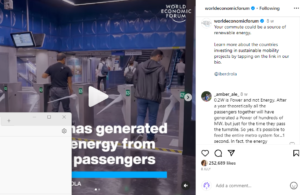
The album video shared by the WEF in July 2023 has become the most viewed video, with 4.58 million views. The video shows turnstiles transformed into mini turbines in the Paris metro, claiming that the energy produced could power an entire metro line.
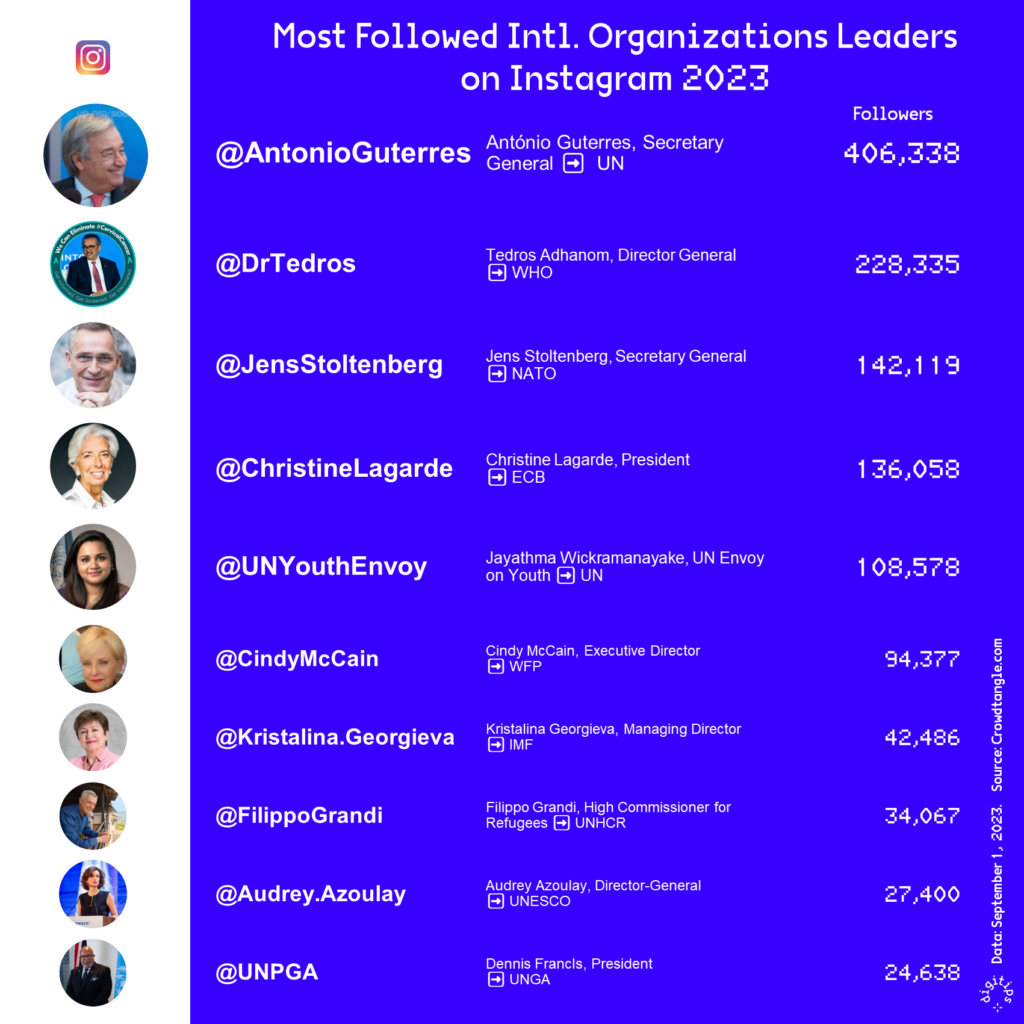
Sixty leaders of international organizations have an Instagram account. However, 14 of these are private accounts and 25 are inactive, leaving only 21 active accounts.
UN Secretary General António Guterres is the most followed, with 406,338 followers – this is almost twice as many as the WHO Director General, Dr Tedros Adhanom, with 228,335 followers.
NATO’s Secretary General Jens Stoltenberg, the ECB’s Christine Lagarde, and the UN Youth Envoy Jayathma Wickramanayake complete the Top 5 list of the most followed leaders accounts.
All leader accounts have a combined following of 1,365,706 followers and have been growing on average by 11% year-on-year which is exceptionally good.
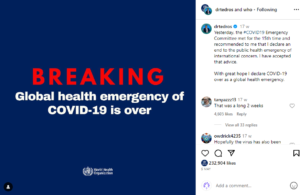
The best way to make an impact on Instagram is to ‘collaborate’ with other large accounts and influencers. The ‘breaking news’ announcement of the end of the COVID-19 global health emergency, shared by Dr Tedros in collaboration with the WHO has become his most popular post.
UNICEF has co-shared posts with Indian actress Priyanka Chopra (89 million followers), British actress Millie Bobby Brown (63 million followers) and Leonardo di Caprio (60 million followers). Since July 2023 Instagram users can add up to three collaborators in one single post, hence we might be seeing more collaborative posts in the future.
LinkedIn
“LinkedIn Is Cool Now”, wrote Sarah Frier, San Francisco Tech Team Lead at Bloomberg. The professional social networking platform has clearly benefitted from the slow decline of X.
Ninety-seven of the 106 organizations in this report have official company pages on LinkedIn and are active on the platform. All LinkedIn pages combined have a total of 55.8 million followers and a median average of 194,415 followers per page.
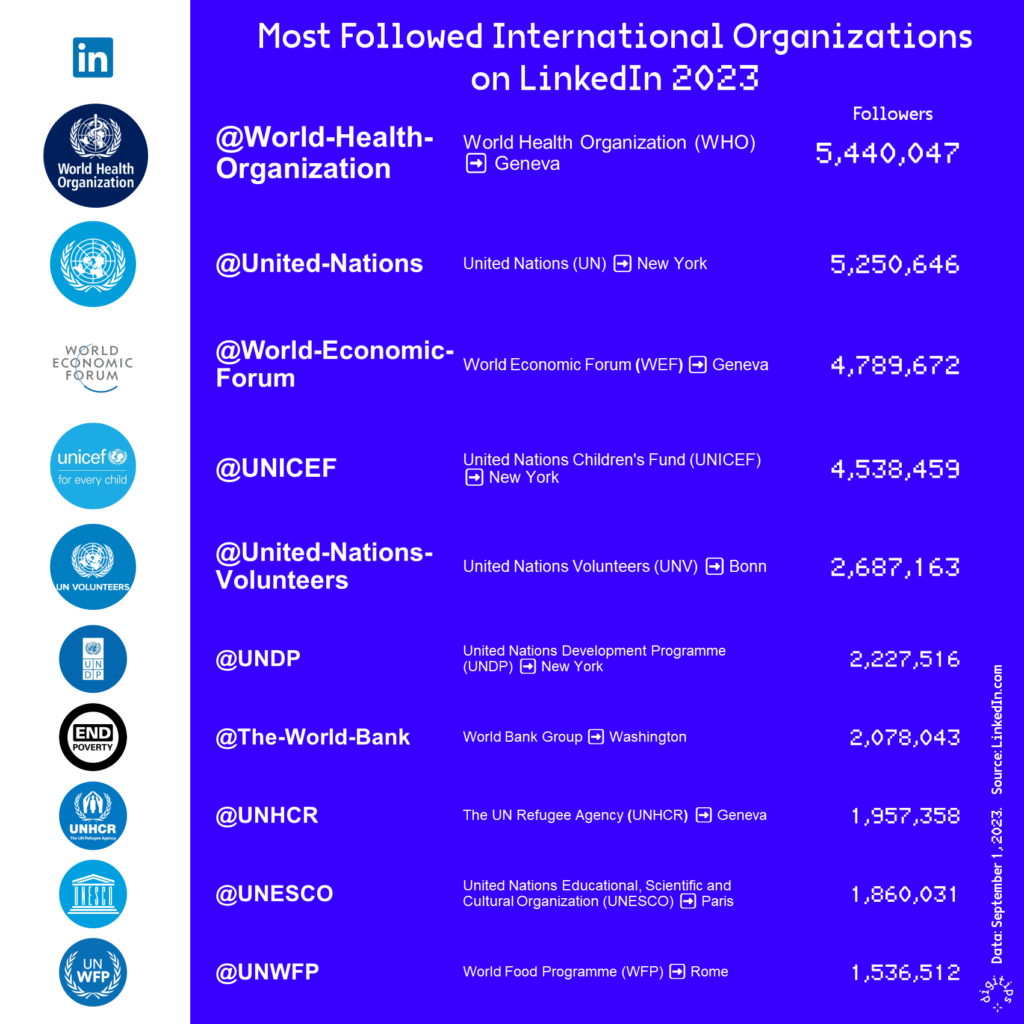
The WHO is the most followed organization with 5.4 million followers, slightly ahead of the United Nations page with 5.2 million followers. The WEF, UNICEF both have more than four million followers and among the Top 5 pages is that of the United Nations Volunteers organisation.
LinkedIn – self-proclaimed “the world’s largest professional network” – is the perfect fit for the leaders of international organizations ; 74 have personal LinkedIn profiles.
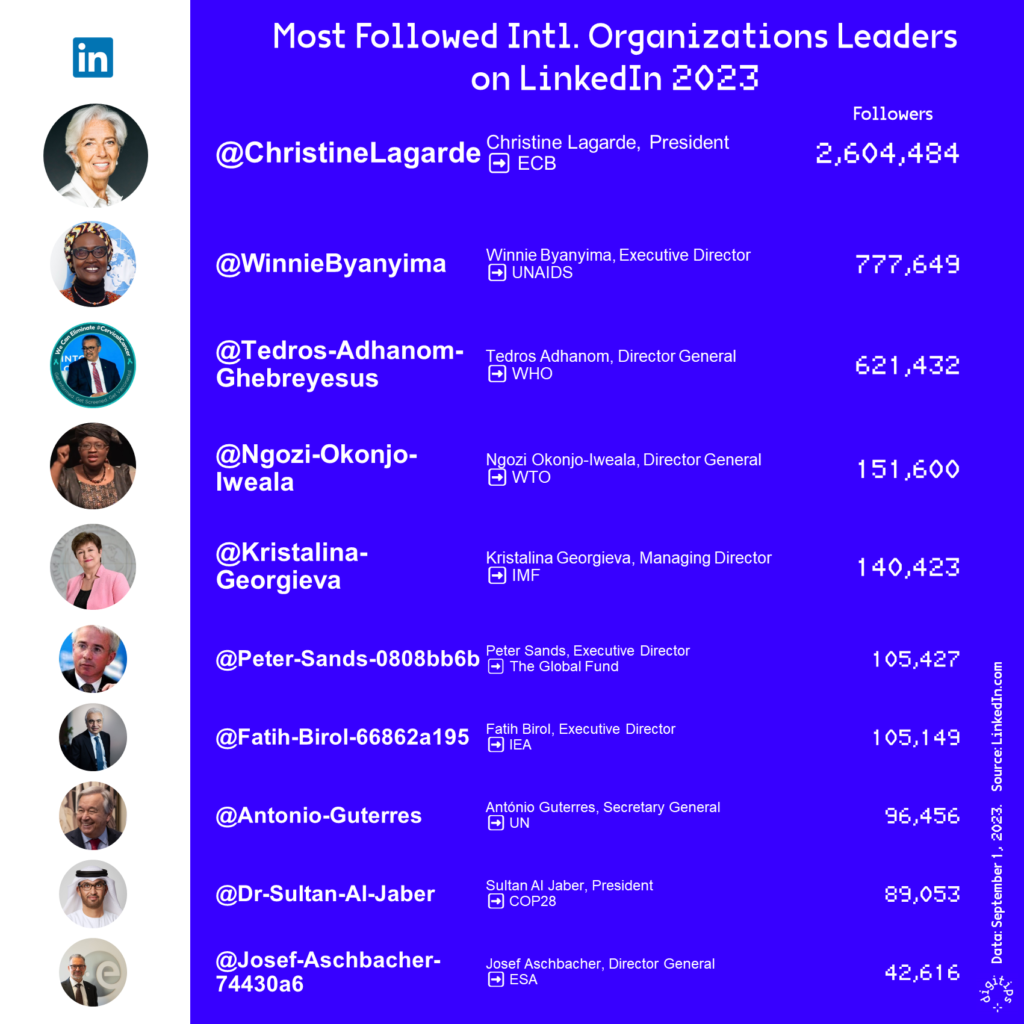
Christine Lagarde, President of the European Central Bank (ECB), is by far the most followed leader with 2.6 million followers. Winnie Byanyima, UNAIDS Executive Director, and Dr Tedros Adhanom, Director General of the WHO, are in second and third place with 777,649 and 621,432 followers respectively.
UN Secretary General António Guterres, who joined LinkedIn at the end of March 2023, makes it into 8th place.
Embarrassingly, many executives have not created a custom URL for their LinkedIn profiles and have kept the number combination at the end of their profile URLs.
Twelve executives are part of the Top Voicesprogram, an invitation-only group of experts across the professional world who are being promoted on the platform. It is no surprise therefore that the first nine leaders on the list below have the Top Voices label. The three other top voices are UNEP’s Inger Andersen, HRW’s Tirana Hassan and UNV’s Toily Kurbanov. LinkedIn’s top voices are encouraged to be personally active and post original personal posts and articles. And finally, the Top Voices badge cannot be bought. LinkedIn is currently rolling out a Community Top Voices label for users who share their expertise and point of view in collaborative articles.
Sixteen organizations have created newsletters on LinkedIn with smashing results. The newsletters have a median average subscription of 230,000 and the WHO’s Health for All newsletter counts 1.5 million subscribers.
X
Whether you like it or not, X (formerly Twitter) remains the dominant social-media platform for most international organizations. X is notably listed as the first or second social network after Facebook on the social-media boilerplates on the websites of three-quarters of the 106 organizations. One month after the rebranding of Twitter to X, the bluebird still graces the websites of most international organizations as if they were secretly it will somehow revive.
None of the international organizations commented on the sudden rebranding, but some used it to their advantage. The World Wide Fund for Nature (WWF) put it squarely: “Twitter’s iconic bird isn’t the only one disappearing.👉 Today, one in eight bird species are at risk of extinction.” The World Intellectual Property Organization (WIPO) asked its followers: “What other single-letter logos do you know?”
The relationship between international organizations and Elon Musk has soured since the sale of Twitter in November 2022. In early November the United Nations Human Rights office shared an eight-part thread from Volker Türk, the UN Human Rights Chief, reminding Elon Musk of the human rights responsibilities of companies to stop disinformation and ensure privacy and transparency and access to the platform’s data. “#FreeSpeech is not a free pass. Help us stop the viral spread of harmful disinformation, such as we saw during the Covid-19 pandemic in relation to vaccines. Don’t amplify content that results in harm to people’s rights” the organization said.
Elon Musk has repeatedly attacked the United Nations and UN agencies on his platform; few have reacted to his antics. In June 2023 he claimed, without further proof, that “The UN is more likely to cause, rather than prevent, disinformation”. When Elon Musk stated in June 2023 that “Countries should make their own decisions and not rely on UN bodies like WHO”, Dr Tedros, the WHO Director-General, shot back a couple of hours later: “Countries aren’t ceding sovereignty to @WHO.”
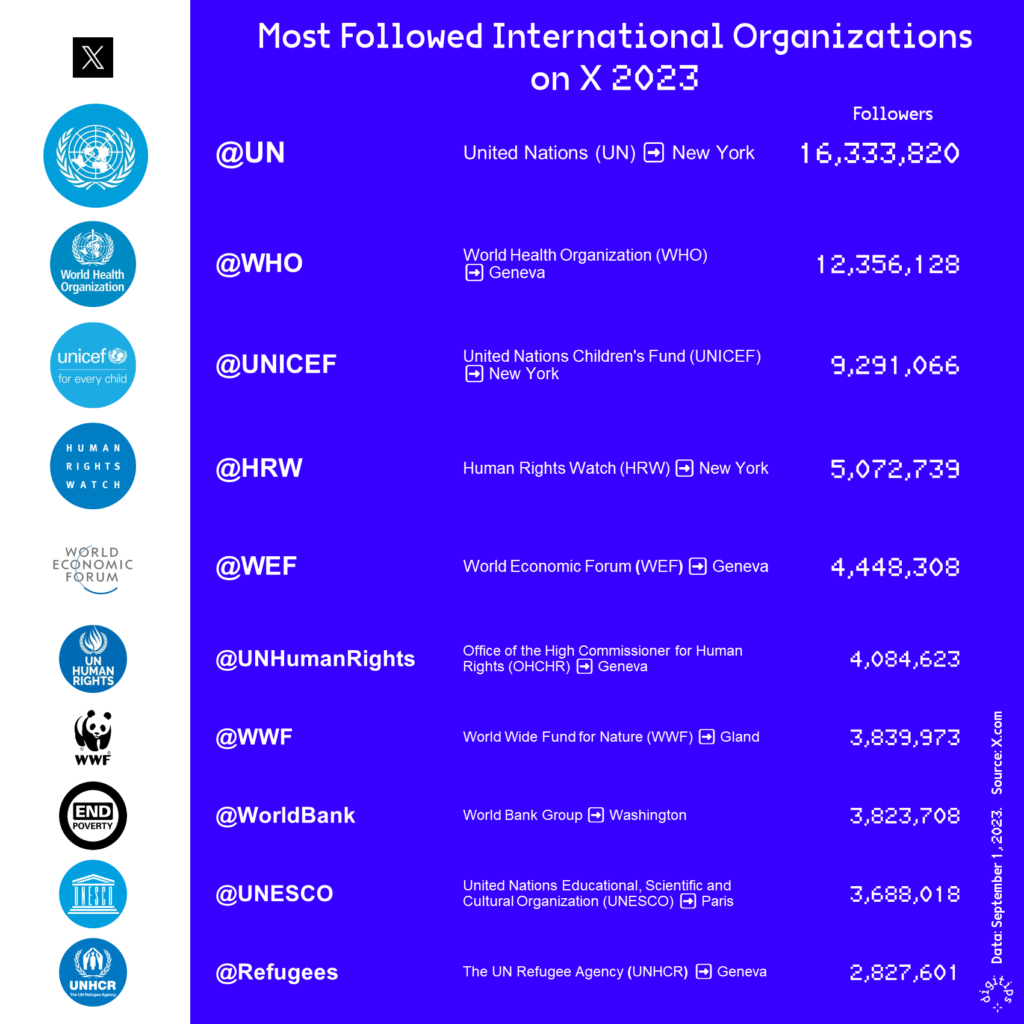
The United Nations @UN account, with 16 million followers, is the most followed international organization on X. The World Health Organization @WHO is in second place, with more than 12 million followers. Both organizations also top the ranking of the most listed organizations, appearing on 45,699 and 35,381 lists respectively which is a probably the best gauge of influence on the platform. UNICEF, Human Rights Watch and the WEF complete the Top 5 list of the most followed organizations on X.
The 106 institutional accounts have a combined following of 124,428,511; the median average number of followers standing at 212,319 for each account. The WWF has been the most prolific organization on X, with over half a million posts since inception in February 2008. The WEF has posted 179,000 times, often repeating posts up to 10 times to reach new audiences in different time zones.
Almost all leaders of international organization have personal or branded personal accounts on X. Only a handful of leaders are still resisting to engaging personally on social media. Obviously, most leaders have outsourced their social media activity to their social media teams, but some are taking matters into their own hands.
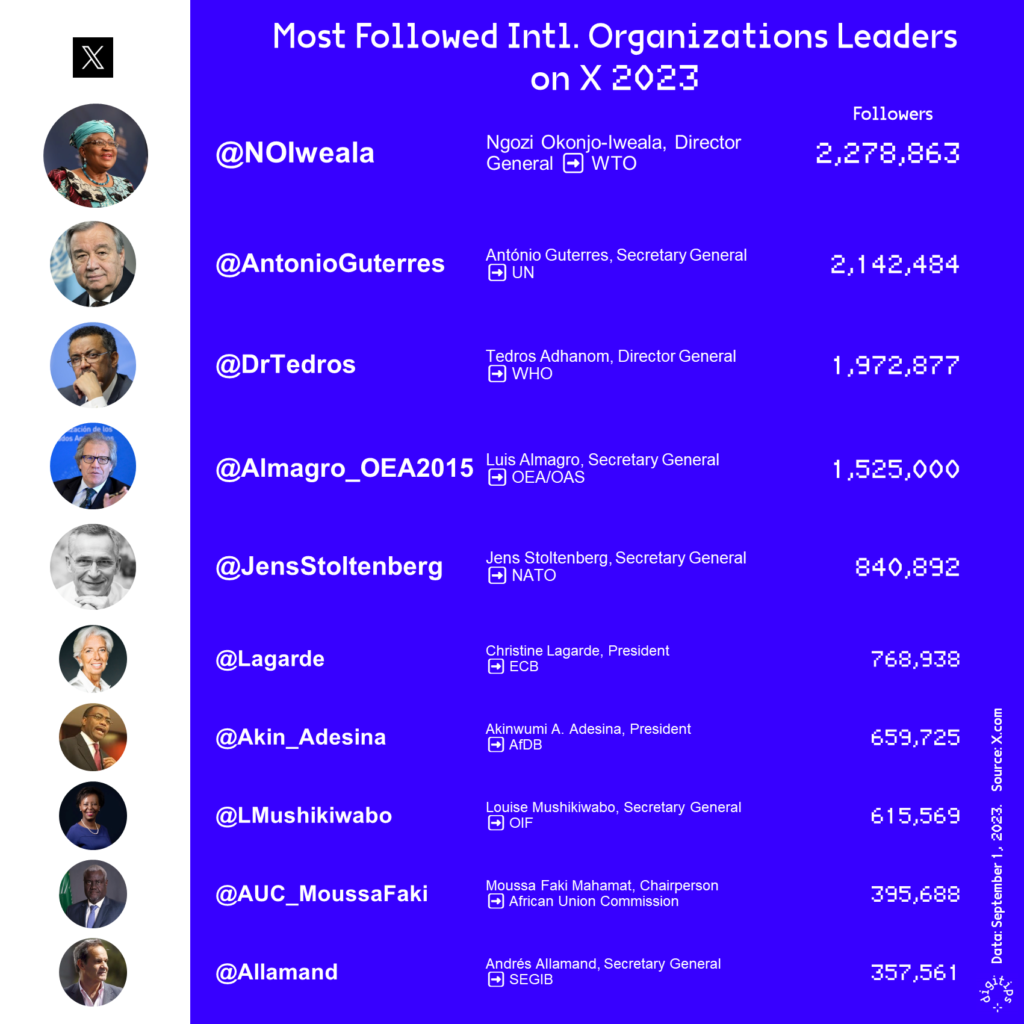
Ngozi Okonjo-Iweala, Director-General of the World Trade Organization, is the most followed leader with 2.27 million followers ahead of UN Secretary General Antonio Guterres and WHO Director General Dr Tedros Adhanom Ghebreyesus with 2.14 and 1.97 million followers respectively.
The 101 personal accounts have a combined following of 16,322,955 and the median average stands at 20,197 followers for each personal account.
Most leaders have staff taking pictures of their activities and ghost-posters preparing their personal social-media posts. But some also know how to take matters into their own hands. Dr Tedros Adhanom occasionally shares pictures playing with his grandchildren to show a more personal side of the WHO’s Director General.
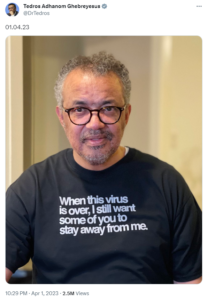
On April Fools Day 2023, Dr Tedros posted a selfie showing himself wearing a T-shirt with the inscription: “When this virus is over, I still want some of you to stay away from me.” The post went viral, with many of his critics and anti-vaxxers replying that the feeling was mutual. You need to be thick-skinned to take the amount of abuse on the platform.
At the end of April 2023 all previously verified accounts, including international organizations lost their blue tick. The ICRC was quick to promote its 48 regional and country accounts which are no longer marked as official. Organizations such as Eurocontrol, GAVI, ISO, IUCN and the United Nations Foundation also lost the precious verification badge.
A couple of days later, verification was re-instated for most organizations with a grey badge denoting a multi-lateral organization or a gold badge for other international organizations and companies. Organizations sporting grey, or gold badges do not subscribe to the premium service, although the time will undoubtedly come when they too will have to pay for the service or lose their badge.
The Organization of Ibero-American States (@EspacioOEI), the Organization for the Prohibition of Chemical Weapons (@OPCW), the Union for the Mediterranean (@UfMSecretariat), the WHO and its Director General Dr Tedros Adhanom have also subscribed to the premium service. This allows them to share longer posts and videos, highlight top posts on their profile, get priority ranking in replies, among among other smaller perks. But these accounts haven’t created any list of affiliates yet.
It remains to be seen whether other organizations will follow their lead and succumb to paying to play on Elon Musk’s platform.
TikTok
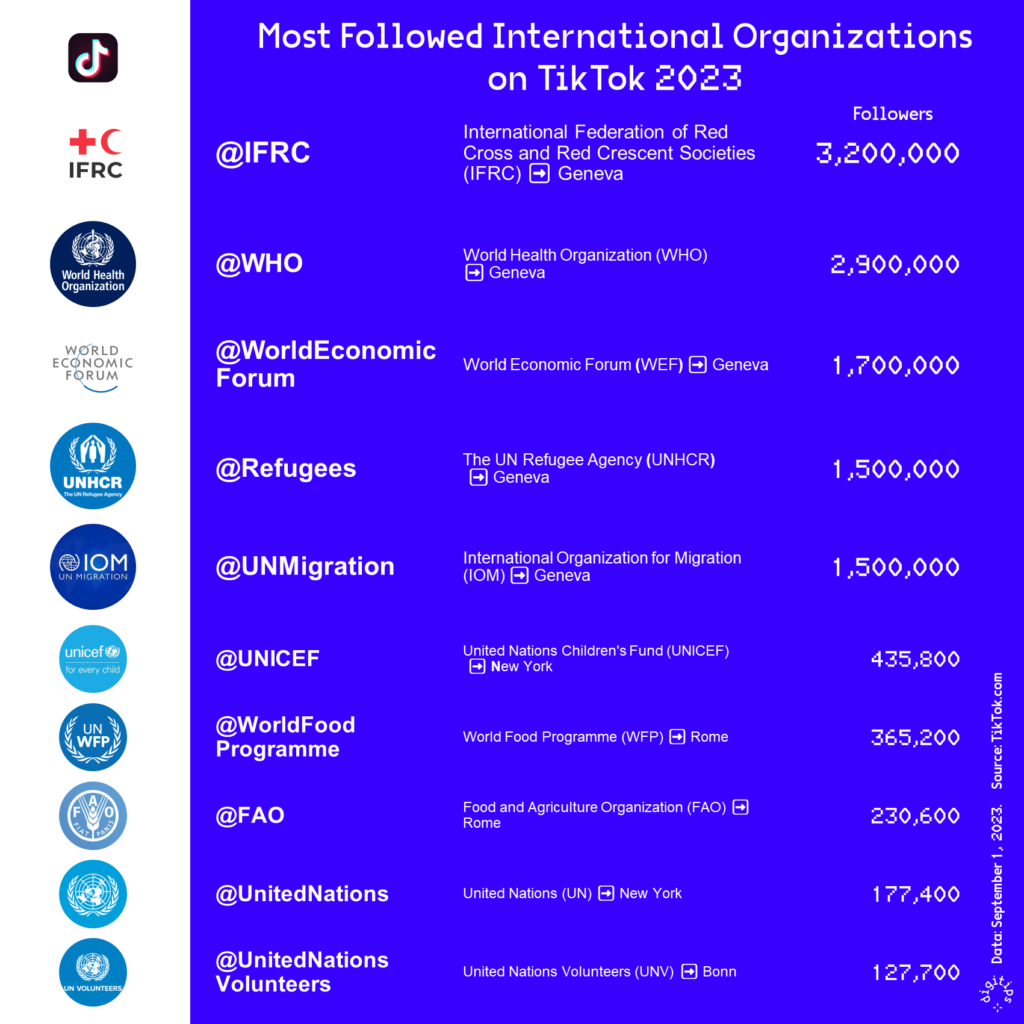
Almost half of the 100 organizations surveyed have set up shop on TikTok, the Chinese-owned video-sharing platform which had its heyday during the COVID-19 pandemic. At the time, TikTok helped onboard international organizations through the Elevate programme and their videos would reach millions of views making the platform a must for international organizations.
Fast forward to 2023. Only 29 organizations remain active on TikTok and many struggle to produce sticky, viral videos for the platform. The UN Refugee Agency (@Refugees) has registered 230 million views on its 89 videos this year so far thanks to several viral hits in the run-up to World Refugee Day, such as: this video recalling the appalling refugee figures worldwide ; this one with refugees explaining what gives them hope away from home ; and this one on how to help refugees.
However, the median average views of UNHCR’s videos stands at only 4,227. The World Food Programme is the most successful, with their TikTok videos generating on average 35,000 views. The WHO, which has a median average of 99,400 views on all its videos, is only getting 5,100 median average views on the 58 posted in 2023. The same is happening to the IFRC and UN Migration, two organizations which originally championed the use of TikTok.
The International Federation of Red Cross and Red Crescent Societies (IFRC) is still the most followed international organization on TikTok, with 3.2 million followers and 12 million likes. WHO is in second place with 2.9 million followers and the World Economic Forum is the third most followed organization, with 1.7 million followers and a record 18.4 million likes.
The number of followers on TikTok is rather meaningless and doesn’t automatically guarantee video views. The algorithm analyses each video and the engagement, meaning even accounts with few followers can score a viral hit.
The World Economic Forum is also the most active of all international organizations on TikTok, with a total of 1’835 and 297 in 2023 alone. However, the median average view count of each video stands is only 2,700.
Few organizations produce quirky content, tailored to the platform. Most tend to post professionally produced clips which they also share on other platforms. These videos look good but are not viral TikTok material.
YouTube
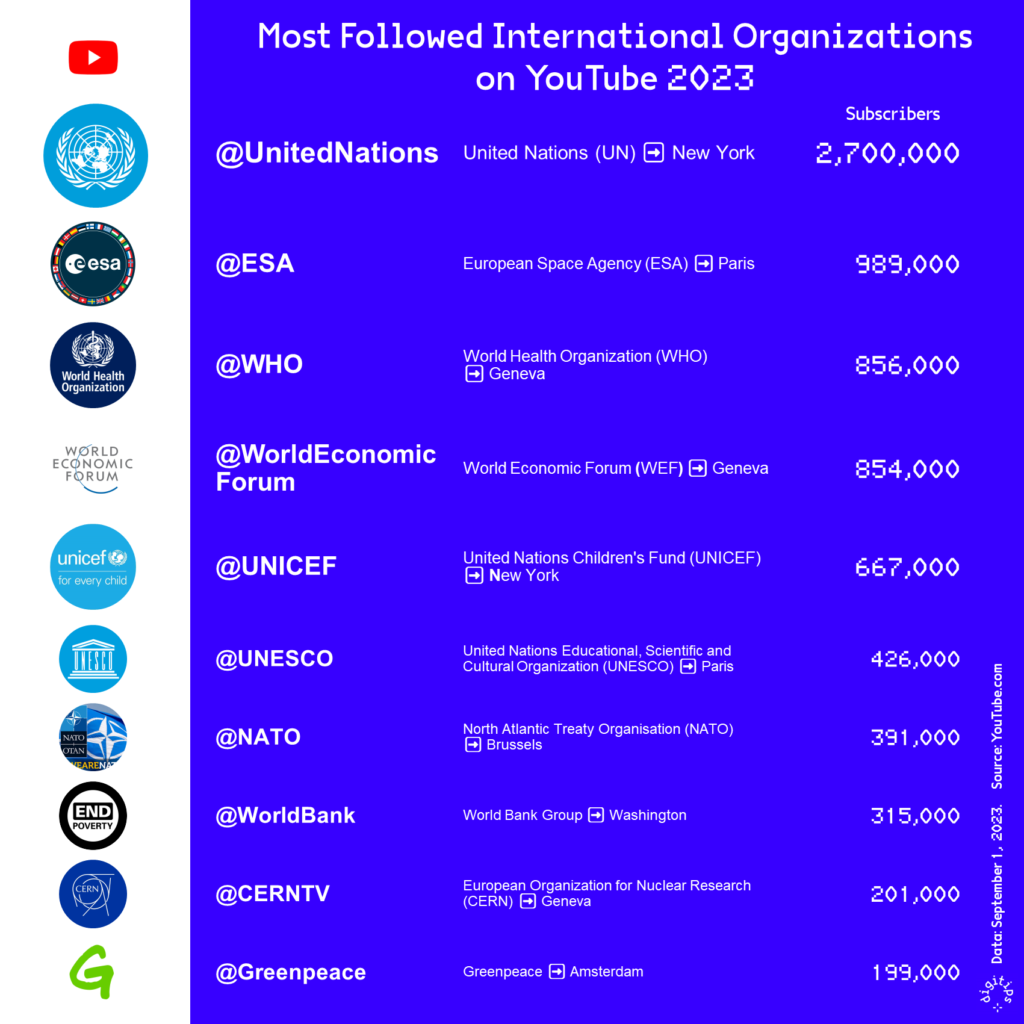
YouTube is still an important channel to host videos and all but five of the 106 organizations have a dedicated channel. All channels combined have over a billion subscribers and the median average number of subscribers is 18,400.
The United Nations channel is the most popular, with 2.7 million subscribers and has clocked up a record 372 million views on its 15,000 videos.
The UN live streams public events from the Security Council and has a live broadcast from the annual UN General Assembly in September. The UN also has dedicated channels in all five official UN languages, namely Arabic, Chinese, French, Russian and Spanish, featured on its page.
The European Space Agency (ESA) has the second most-followed channel, with close to a million subscribers. ESA often shares videos from its astronauts on the international space station. The WHO, the WEF and UNICEF complete the list of the Top five most subscribed channels.
Greenpeace gets the best average views per video, with more than 100,000 average views for each of its 975 videos. Greenpeace is known for its impactful viral video campaigns. Its latest video posted at the end of August 2023 accuses the French oil company Total Energies of greenwashing as the main sponsor of the Rugby World Cup 2023.
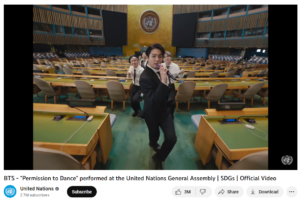
The UN’s most watched video, with 85 million views, is the clip of the Korean boy band BTS dancing in the General Assembly Hall. The clip, posted in September 2022, is by far the most watched video of any international organisation.
All but 16 channels have posted Shorts, YouTube’s 60-second vertical videos. Shorts were released worldwide in July 2021 and are a great way to recycle vertical videos produced for Instagram or TikTok. However, many channels are posting square videos, which is sub-optimal given the vertical format.
A third of the 101 channels are verified by YouTube which requires at least 100,000 subscribers. Seven channels have the precious grey badge without having the required threshold.
Snapchat
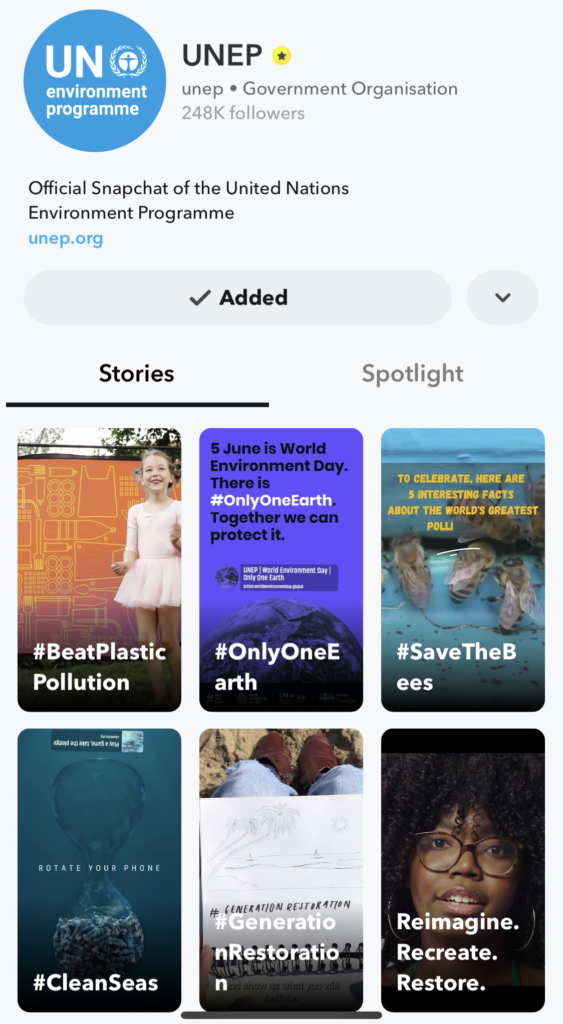
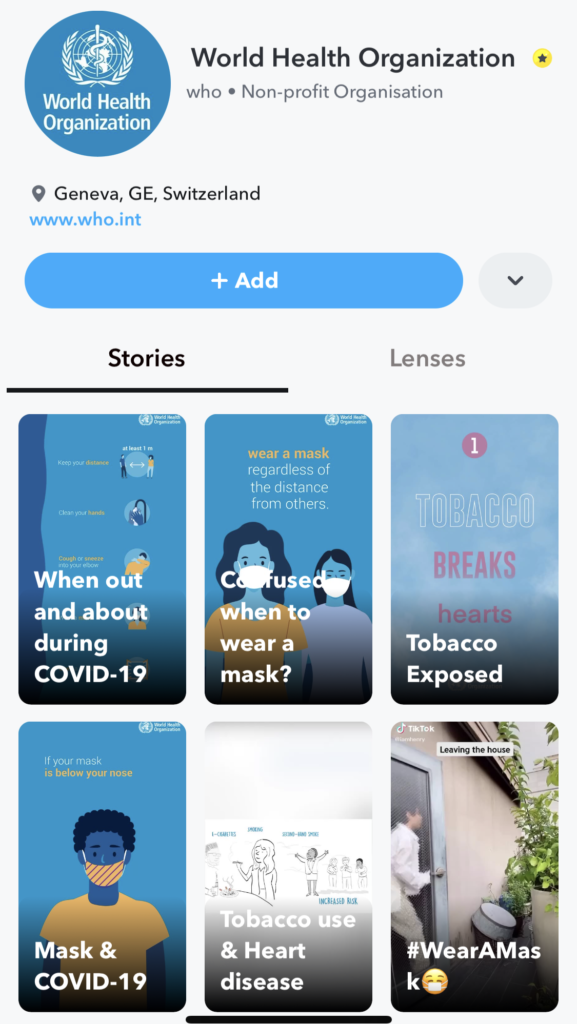
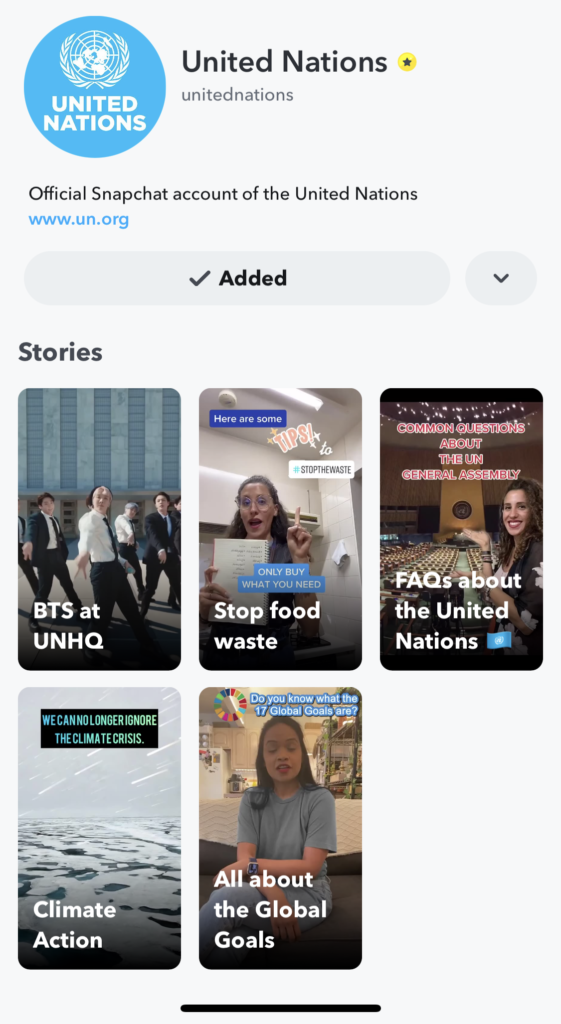
Only 12 international organizations have a presence on Snapchat and only three of these have created public profiles, namely the UN, the WHO and UNEP, the UN Environment Programme which boasts 249,000 subscribers. It definitely makes sense for organizations to set up a public profile on Snapchat and become active to reach a younger audience.
UNEP Snapchat profile WHO Snapchat profile United Nations Snapchat profile
Bluesky
Human Rights Watch (HRW) is the only international organization to set up shop on Bluesky, a new federated social media platform which has so far refused to onboard large organizations.
The platform – a spin-off from Twitter – is funded by Twitter co-founder Jack Dorsey. HRW has set up separate accounts in English, Arabic and Spanish and counts 1.500 followers on the platform which is still in private beta and has 856,508 users. Ping @DigiTips if you need an invite.
Mastodon
UNEP is one of a handful of international organizations to set up an account on Mastodon at the end of 2022, including a personal account for Executive Director Inger Andersen.
Only three organizations, namely Human Rights Watch, the IEC, and UNEP are actively posting on Mastodon, although engagement seems to be close to zero. Despite the abysmal engagement rate, Human Rights Watch has attracted more than 10,000 followers.
Since Mastodon is a federated social network, the organizations have set up on three different instances (servers) which makes finding and following them a challenge.
Threads
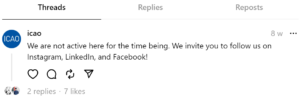
So far only 42 of the 106 institutions and eight of their leaders have signed up to Threads. Most European-based organizations are not yet registered given Threads is not available in Europe.
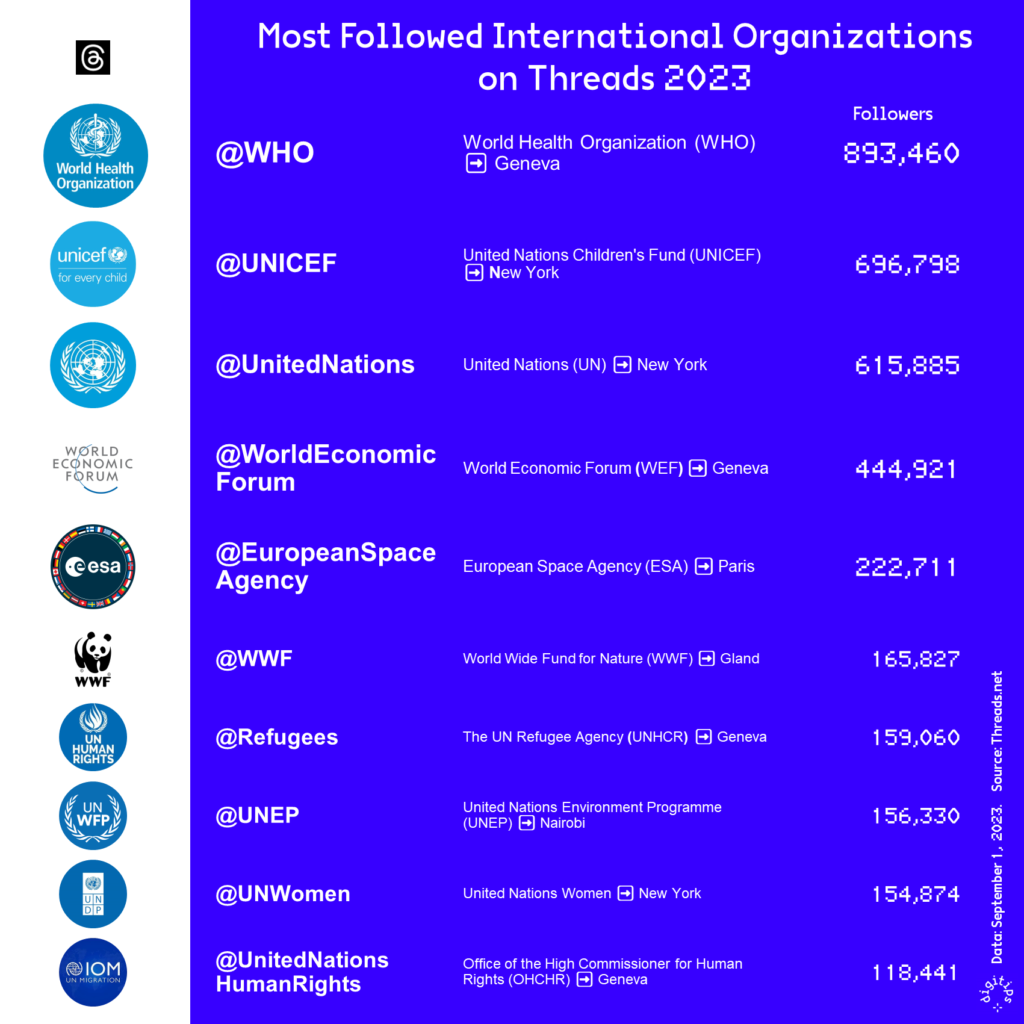
Despite the geo-fence, Geneva-based WHO is the most followed organization on Threads with 893,460 followers. The WHO is also the most active with a post a day. It is followed by UNICEF and the United Nations with more than 600,000 followers. The WEF and the European Space Agency complete the list of the Top five most followed accounts.
The WHO and the UN are also the most active, posting daily on the platform. All other organizations in the Top 10 list post at least once a week.
However, half of the organizations have only posted once and are not currently active on Threads. Despite having posted only once, the WEF has amassed 444,921 followers. Since Threads is linked to Instagram, some of their 4.8 million followers on Instagram automatically follow them on this new platform.
It remains to be seen if Threads will become a serious competitor for X once users in the European Union can access the platform.
Conclusion
Fifteen years after having set up their first presence on social media, international organisations are now faced with a daunting choice of platforms to chose from. There are the top five – Facebook, Instagram, LinkedIn, X and YouTube – which need constant attention and community management. The question is whether they have the resources and bandwidth to engage on other niche networks or to invest time into new networks challenging the predominance of X.
While organizations have seen their audience grow year-on-year, one thing has remained constant over the years: the size of social-media teams. It is time for organizations to recognize the essential work of social media managers and understand that digital-media relations are no longer an after thought, but a key business function with the direct involvement of all employees including the chief executive.
The full study including the data tables is available here for €9.99. Matthias Lüfkens Geneva, 10.09.2023
A couple of months ago the @DigiTips account subscribed to Twitter Blue which is now called @Premium. Here’s a detailed look at the different perks and if it is worth it:
➡️ Long-Form Posts Long-form posts are antithetical on a micro-blogging platform. It is certainly practical to post long-form articles on X, so users don’t have to click on a link to read the full story on another website. However, since posts get cut after 280 characters, we are not sure many will click to “see more”. Essentially long-form posts do not suit this platform and a well constructed thread might attract more engagement and eyeballs.
➡️ Bold and italic formatting Bold and italic formatting are a nice addition to highlight specific words or quotes. Especially in long-form posts, but it’s essentially cosmetic.
➡️ Prioritised Ranking The prioritized ranking in replies and search might be one of the most compelling reasons to take out a Premium subscription. However, don’t expect all users who engage with a post to see your specific reply, even if it is first comment under a post. The verdict is out whether Premium subscribers are systematically prioritized in search. When we searched for accounts “Digital Tips” our own ‘verified’ account @DigiTips didn’t come out on top. When we searched for the hashtag #DigitalDiplomacy our account was upstaged by ten other unverified accounts. Please give it a test drive and let us know if our DigiTips account comes out on top.
➡️ Undo Post Premium subscribers can undo a post within 30 seconds, a useful feature if you spot a last-minute mistake
➡️ Edit Button The edit feature is handy giving you 60 minutes after posting to correct a typo or improve formatting. In any case, it’s always better to proofread your post beforehand or have a secondary protected account to preview your tweet before posting.
➡️ Longer Videos We haven’t posted any longer videos, so we’ll pass judgement on that feature. Our advice is: keep your videos short and under 140 seconds.
➡️ Media Studio Access to the Media Studio is now reserved for Premium subscribers only and one of the perks worth paying for. Uploading videos via the Media Studio gives you lots of additional options such as adding a title, a description and a category to each video which will display below the video once posted. It also let’s you share the link to the draft video with other accounts and allows the easy addition of subtitles which are all features worth paying for.
➡️ X Pro (formerly Tweetdeck) @Pro, formerly known as Tweetdeck is only available to Premium subscribers. The tool allows users to easily monitor multiple columns and tabs with lists and search. For power users that is probably something worth $8.
➡️ Bookmark Folders We don’t know how many folders you need to bookmark tweets. One bookmark folder is ample for us and that is free.
➡️ Less Ads The amount of ads on X can be annoying, especially those for online games which are rather distracting. Seeing 50% less is much appreciated.
➡️ Highlights Premium users can highlight important tweets. Have you seen the highlight on our profile? Probably not. Here’s the link: https://twitter.com/DigiTips/highlights
➡️ Community Only Premium subscribers can create a Community, a public gated group which is useful for discussions on a specific topic.
➡️ The Blue Checkmark The blue checkmark, which was once a coveted symbol of Twitter nobility has become a badge of shame. No wonder X allows Premium users to hide the blue tick from their profiles.
While some features such as @Pro and the Media Studio are worth the monthly $8 fee for individuals, it is another question whether non-profit and international organisations have the budget to shell out $12,000/year plus $600/year for each affiliate account.
For the moment we will keep our subscription, simply because the long-form posts give us ample space to tag 50 users which comes in handy to ping these users about our upcoming ranking.
Twitter is dead. The social network that many of us have come to love over the past 17 years is no longer. It was killed by its new owner Elon Musk and renamed X in what might go down in history as one of the most fateful corporate rebranding.
Many social media managers have been put off by the transformation of the platform into a subscription platform over the past year and by the antics of its new owner. But what are the alternatives?
Threads, the social networking platform launched in July 2023 by Meta has seen explosive growth since as it is integrated with Instagram and counted 124 million users. However, the app is only available in 100 countries and has not been rolled out in the European Union yet. The platform could become a serious competitor to X if it increases engagement and builds more functionalities as it is rather basic for the moment. In any case, it is probably wise to set up a Threads account if you haven’t done so yet.
Mastodon is a crowdfunded social media network which was launched in 2016. The decentralized platform has tripled its users since Elon Musk’s purchase of Twitter in November 2022. The 10 million registered users are accessing the network from 10,000 different nodes/servers which makes finding and following other users challenging to say the least. Posts on Mastodon are called “toots” and reposts are called “boosts”. The founder of the platform has vowed to keep Mastodon free, open source and ads-free.
Koo is an Indian social network platform which was released in early 2020 and has grown partly as an alternative to Twitter namely in India, Nigeria, and Brazil. The Bangalore-based network counts 60 million users including official accounts of the governments of Brazil, India, and Nigeria. Its logo is a small yellow bird, and its mission is “to unite the world despite its language barriers”, according to its co-founder Mayank Bidawatka.
Bluesky was born in 2021 as a Twitter spinoff with the aim to build a decentralized social network protocol. The platform, funded in part by Twitter co-founder Jack Dorsey is still in private beta but has grown to 500,000 users. The platform feels very much like Twitter in the early days. The Bluesky team is often requesting user input as they build the platform but has so far refused to onboard large accounts. (If you need an invite, contact us)
T2 Social is a social network started by two former Twitter employees and launched in late April 2023. The platform, which is still in private beta, has only 14,000 users and is growing as each user can invite their friends. Posts are limited to 280 characters, and you can only post pictures but no videos. (If you need an invite, contact us)
Hive promises to “bring back what you used to love about social media in a new way” with “all friends displayed fairly in chronological order”. The app also profited from the Twitter exodus in late 2022 and made headlines for being run by a three-member team managed by 24-year-old founder Kassandra Raluca Pop.
Spill is the most fun and creative platform, launched in June 2023 by two former black Twitter employees. Users spill the tea and sip the tea from people they follow. The brew on the platform is visual-led with pictures, gifs, or videos and 90-character captions. The platform aims to create a safer and more inclusive space compared to traditional social media platforms and caters specifically to the black and queer community. The app is still invite-only but has garnered several hundred thousand users. (If you need an invite, contact us)
Among established platforms LinkedIn has clearly benefitted from Twitter’s slow decline with more governments and organisations becoming active on the professional social network which is approaching the billion-subscriber mark. TikTok, the hugely popular video-sharing platform now offers text-only posts, but the new feature hasn’t been widely adopted yet.
It is unlikely that any of these new platforms will ever replace X. X is not dead, X has become a subscription platform where users need to pay to play. Despite these changes it remains one of the most influential social networks with 350 million subscribers. X is still used by almost all governments in the world and for many international and multilateral organisations X is still the first social media platform listed on their websites.
However, X is no longer the sole actor in the microblogging space which has become fragmented and compartmentalized. The key challenge for social media managers is to build or rebuild an engaged community on these new platforms. One thing is clear, it is important to set up accounts on these channels to protect your brand name and please add them to the boilerplate on your website.
Threads is barely a week old but has taken the internet by storm with more than 100 million users. Among them are 103 heads of state and government and foreign ministers from 53 countries who have switched to the new social media platform.
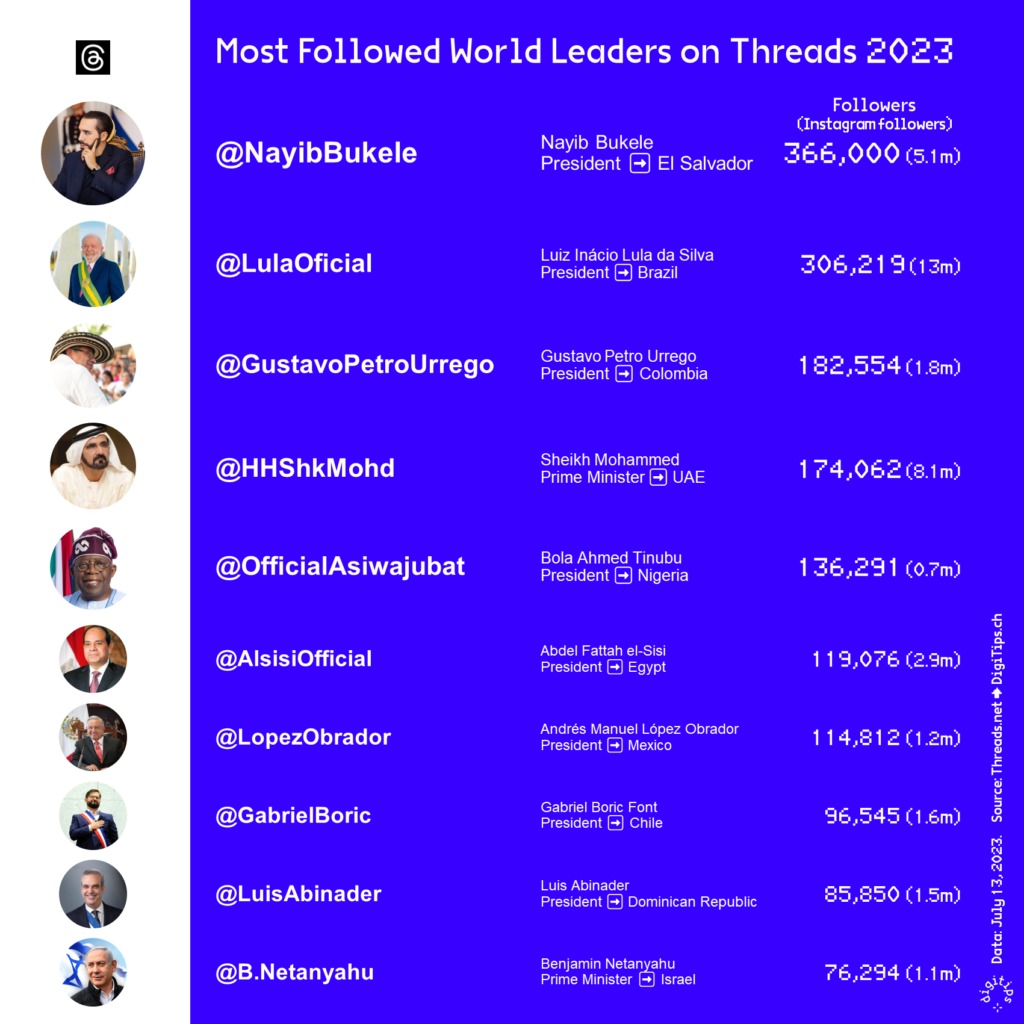
Latin American leaders are the most popular, occupying six places among the 10 most followed accounts. El Salvador’s President Nayib Bukele leads the pack with 366,000 followers. Brazil’s President is in second place with 306,000 followers and Colombia’s Petro Gustavo is in third place with 182,000 followers.
Sheik Mohammed, the leader of Dubai is in fourth place with a respectable 174,000 followers but he hasn’t posted any thread yet. Nigeria’s new President Bola Ahmed Tinubu completes the top 5 list of the most followed leaders with 136,000 followers.
The most followed world leaders on Threads and their followers on Instagram (July 13, 2023)
Among the early adopters are 24 presidents, twelve prime ministers and twelve foreign ministers who have switched their personal Instagram profiles to the new platform. Their follower numbers are still low but are rising daily as new users join the platform and many leaders already have millions of followers on Instagram.
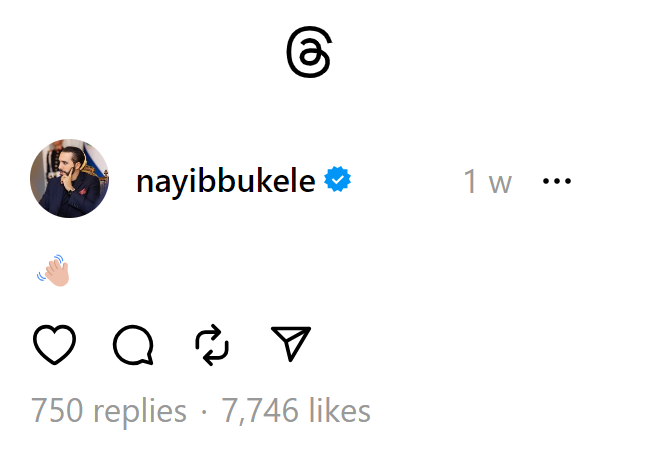
Nayib Bukele’s first post on Threads
Nayib Bukele posted a simple wave emoji as his first thread on July 6 and then told his followers: “I love you, but it’s time for you to go to sleep…” Jamaica’s Prime Minister Andrew Holness posted a video selfie: “Looking forward to making friends and having greater engagement with you. Let’s talk.”
This personal approach seems to work also for Israel’s Benjamin Netanyahu who posted a challenge to his followers: “Who is worth for me to follow? Someone interesting or funny in all areas of life. I have had enough of politics. I will try to respond from time to time 🎉”
So far, no EU government has adopted the platform since the Threads app is not available in the app store in the EU. While the UK Foreign Office and Foreign Secretary James Cleverly have embraced Threads, no G7 leader has yet established an account on Threads.
The welcome post on Threads from the UK Foreign and Development Office
Most of the 660 Instagram accounts of heads of state and government and foreign ministers are still standing on the side lines, evaluating whether it is worth engaging on yet another social media platform.
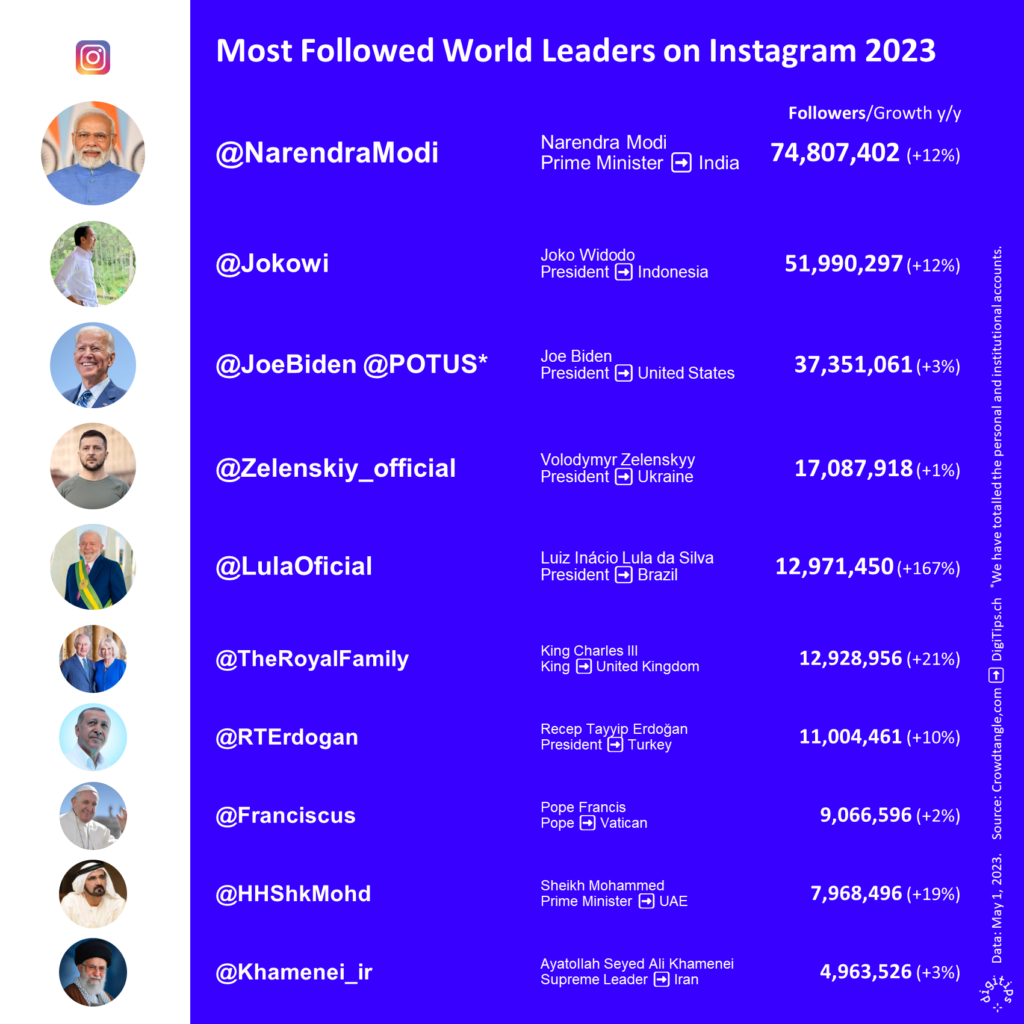
Indian Prime Minister Narendra Modi, is the most followed world leader on social media, topping the rankings on Facebook, Instagram, Twitter, and YouTube.
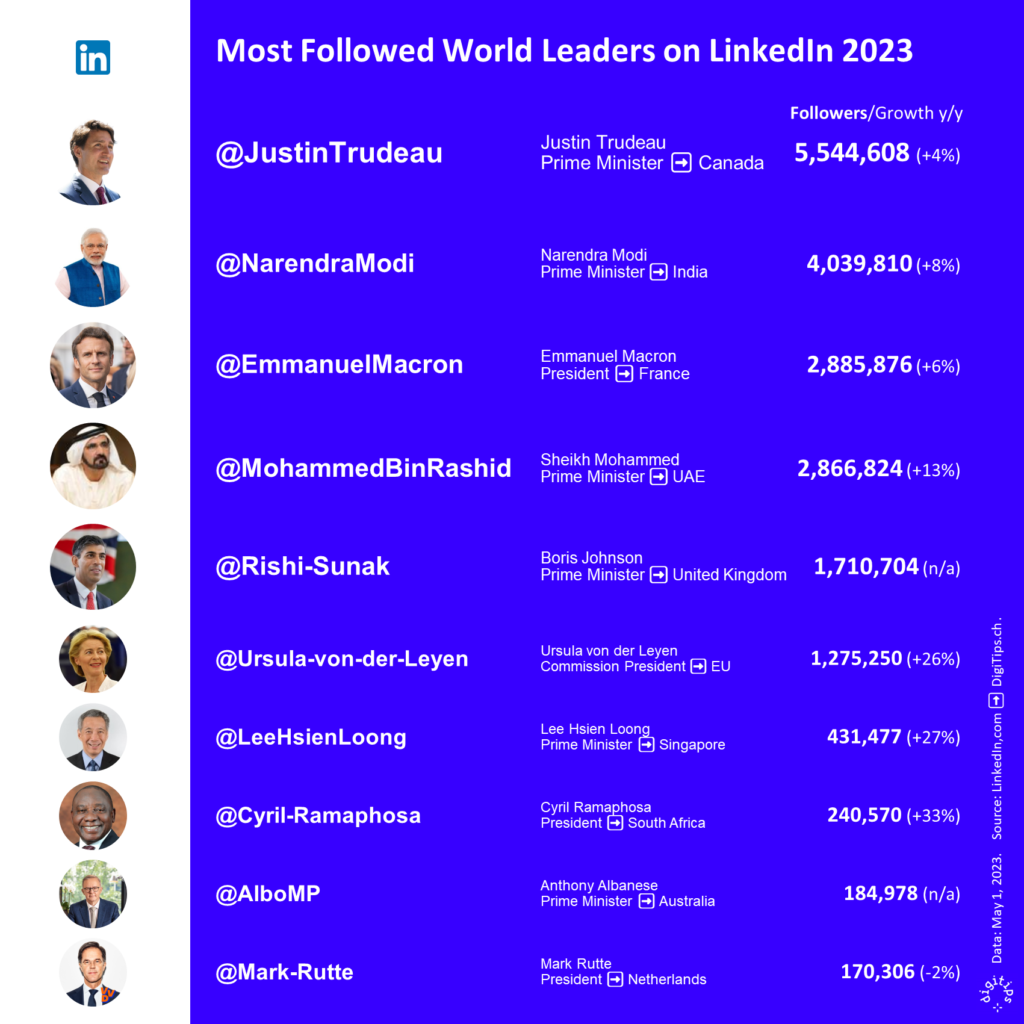
On LinkedIn Canadian Prime Minister Justin Trudeau is still in the lead ahead of the Indian Prime Minister. Surprisingly many elected officials seem to ignore the professional social network, which has seen double digit growth for those who are active on the platform.
Ukrainian President leads the rankings on Telegram and catapulted into the top 10 on many social media channels over the past year.
El Salvador’s President Nayib Bukele is the most followed world leader on TikTok.
Twitter
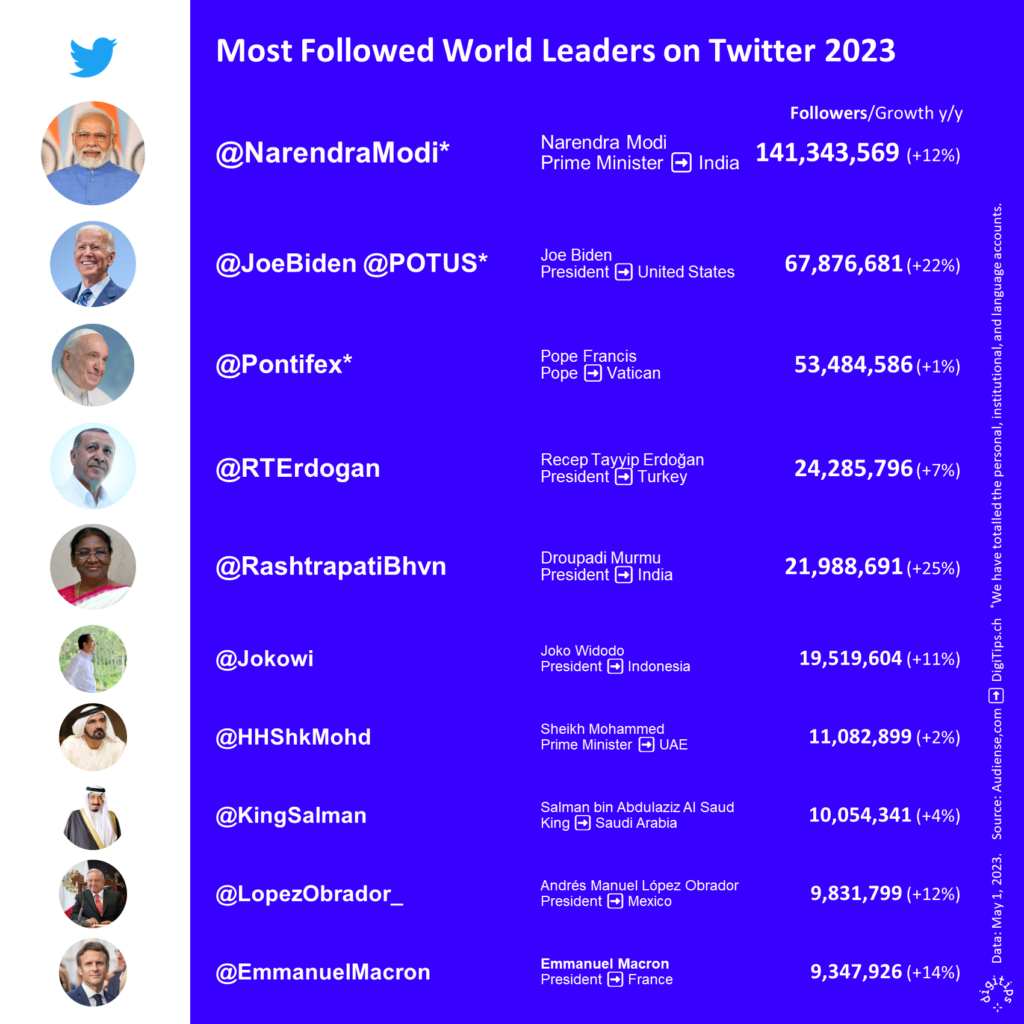
For the third year running, Indian Prime Minister Narendra Modi is the most followed world leader with 88 million followers on his personal Twitter account @NarendraModi and 53 million on his institutional account @PMOIndia set up by his predecessor. With a total combined following of 141 million followers on both accounts the government leader of the most populous nation has slightly more followers than Elon Musk.
U.S. President Joe Biden is in second position with 37 million followers on his personal account and 30 million on his institutional account which he had to build from scratch since his inauguration in January 2021.
Pope Francis is in third place with a total of 53 million followers on his nine language accounts. Turkish President Recep Tayyip Erdoğan and India’s President Droupadi Murmu complete the top five list with 24* and 21 million followers respectively.
The 1,164 Twitter accounts of heads of state and government and foreign ministers have a combined audience of 753 million followers with a median average of 42,563 for each account.
Four hundred of these official accounts have the coveted grey badge verification for government institutions and government officials. Two hundred and eighty accounts have lost their blue badge and join the army of unverified official accounts. So far none of them have dared calling out Twitter or Elon Musk publicly on Twitter.
Some 20 leaders have subscribed to Twitter Blue, including governments and their leaders in Africa and the Middle East but also the Polish President @Prezydentpl and the @PremierRP. After having lost their verification, many are now living in fear of losing their followers with the announced cull of inactive accounts.
Facebook
The 820 Facebook pages of world leaders have a combined audience of 435,267,643 followers and the median average number of followers stands at 69,501 per page.
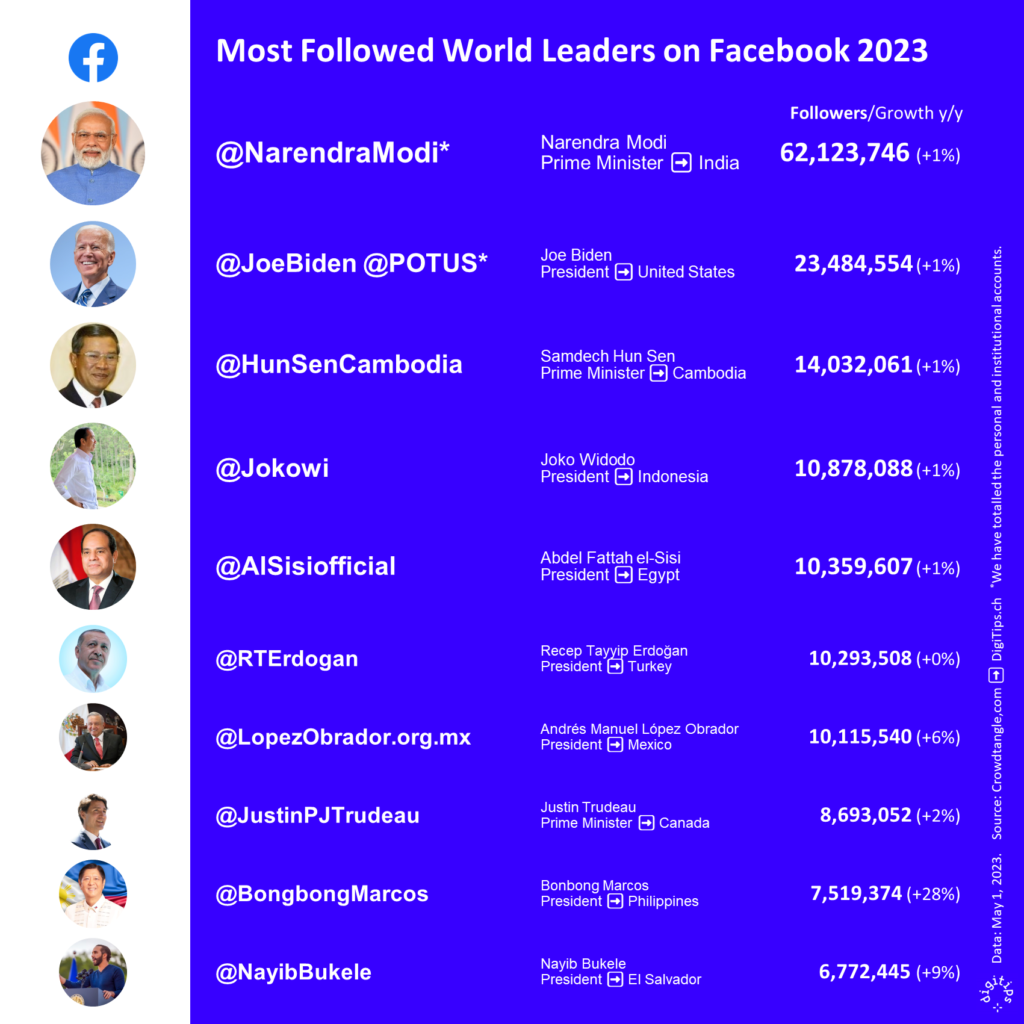
Hun Sen, https://facebook.com/hunsencambodia the Prime Minister of Cambodia is a surprise third place with close to 14 million followers, more than there are Facebook users in his country. Another leader who reaches beyond his borders is El Salvador’s Nayib Bukele who has 6.6 million followers while there are only 4.7 million Facebook users in El Salvador.
The President of the Philippines Bong Bong Marcos who took office in June 2022 has witnessed a 28% growth of his page year on year. He is also in third place with 57 million interactions behind Brazil’s President Lula and Narendra Modi with 64 and 108 million comments, likes, and shares respectively.
Instagram
The 668 Instagram accounts of heads of state and government and foreign ministers have a combined audience of 375 million followers with a median average of 25,051 per account.
Indian Prime Minister Narendra Modi is also the most followed world leader on Instagram with 74 million followers on his personal Instagram account @NarendraModi. Indonesian President Joko Widodo is in second place with 51 million followers ahead of U.S: President Joe Biden who has a total of 37 million followers on his personal @JoeBiden and his institutional account @POTUS.
Since the start of Russia’s attack on Ukraine, Volodymyr Zelenskyy (@Zelenskiy_official) has become the fourth most followed world leader on the platform. Volodymyr Zelenskyy has registered 187 million interactions (likes & comments) and 256 million video views on his 1,948 posts. Luiz Inácio Lula da Silva (@LulaOficial), the President of Brazil has seen his numbers more than double as he was elected president in October 2022.
El Salvador’s President @NayibBukele who is in 11th place with 4.8 million followers has literally wowed his followers with 192,224 wow-reactions on his 390 Instagram posts over the past year.
LinkedIn
Surprisingly, LinkedIn is one of the least used social platforms by heads of state and government. No wonder since these leaders are hardly looking to get a new job. Canadian Prime Minister @JustinTrudeau leads the LinkedIn list with 5.5 million followers ahead of Indian Prime Minister @NarendraModi Narendra Modi with more than 4 million followers.
French President @EmmanuelMacron and the Sheikh @MohammedBinRashid the Prime Minister of the UAE are on the third and fourth places with 2.8 million followers each.
Eight of the 10 most followed world leaders are part of LinkedIn’s Top Voices program, an invitation-only group of experts across the professional world. The Prime Minister of Singapore Lee Hsien Loong and Dutch Prime Minister Mark Rutte are not part of this exclusive club since they are not overly active on the platform.
We have identified 423 LinkedIn pages and profiles of world leaders. The 183 personal profiles combined have a total of 21 million followers and the 240 organisation pages only clock up 8.4 million followers. However, the median average of company pages is 2,327 compared to only 1,085 for personal accounts.
UK Prime Minister Rishi Sunak who is in fifth place with 1.7 million followers organized his first ever LinkedIn live in May 2023 answering prepared questions from selected members of the UK business community. The event about his plans to grow the economy was watched by 91,000 users on the platform.
YouTube
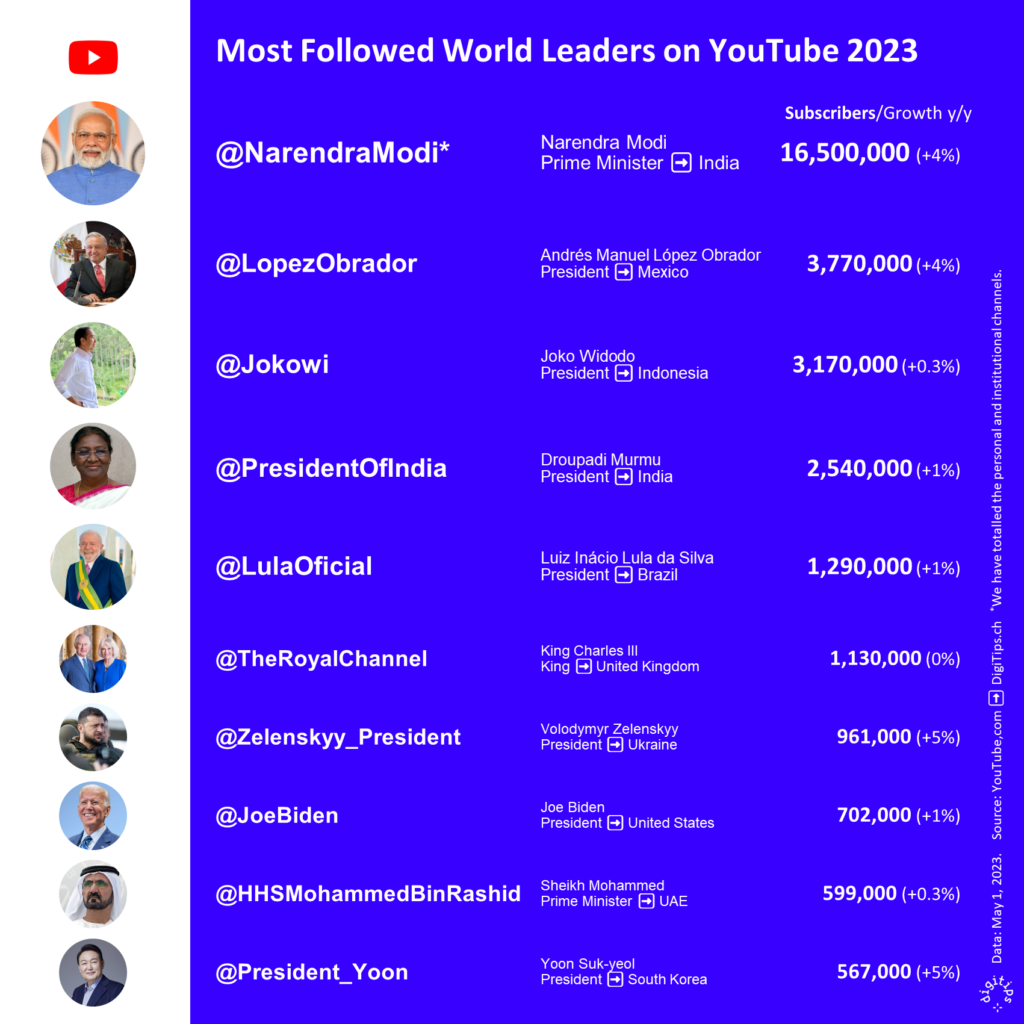
Indian Prime Minister Narendra Modi has 14.6 million subscribers on YouTube, four times as many as each of the runners up, Mexican President Andrés Manuel López Obrador and Indonesia’s President Joko Widodo who have 3.7 and 3.1 million subscribers respectively.
What is even more impressive his 19,000 videos have been viewed 3 billion times with an average of 160,000 views per video. Mexican President Andrés Manuel López Obrador AMLO has registered 1.4 billion views and an average of 450,000 average views per video.
The 449 channels of world leaders have a combined audience of 48 million subscribers and a median average of 3,360 subscribers per channel. In total these accounts have more than half a million videos which are viewed on average 1,648 times.
Most channels only registered minimal growth Ukrainian President Volodymyr Zelenskyy and South Korean President Yoon have seen their subscriber numbers grow by more than 5% over the past 12 months.
TikTok
The heads of state and government in 57 countries have an official presence on TikTok and quite a few are still active on TikTok despite a creeping public sector ban of the Chinese-owned platform in a growing number of Western capitals.
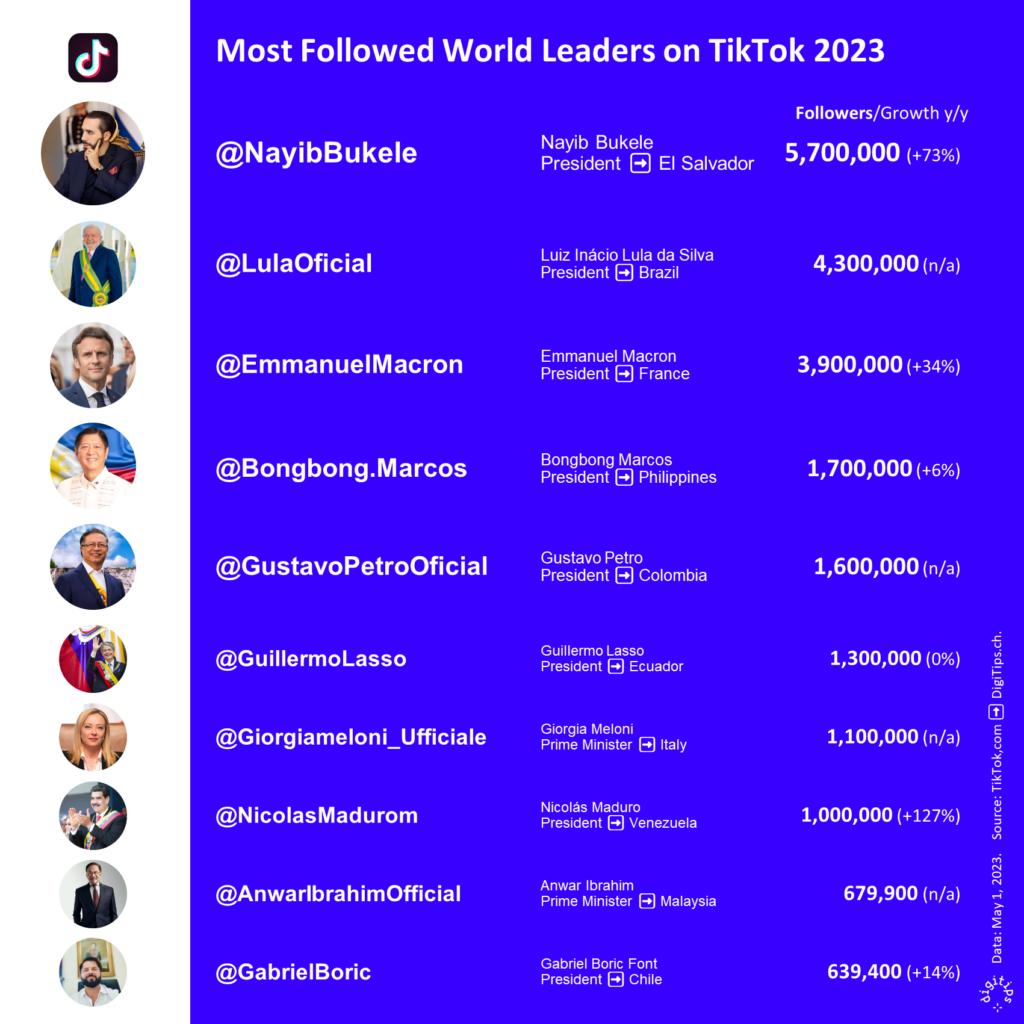
TikTok is widely popular among Latin American leaders and most presidents and governments have an official channel on the platform. El Salvador’s president Nayib Bukele has become the most followed world leader on TikTok. With his 5.7 million followers he is reaching a large Spanish speaking audience far beyond the 6.3 million population of his country. Showcasing his #GuerraContraPandillas (#FightAgainstGangs), his team has started to subtitle his videos in English for a global audience.
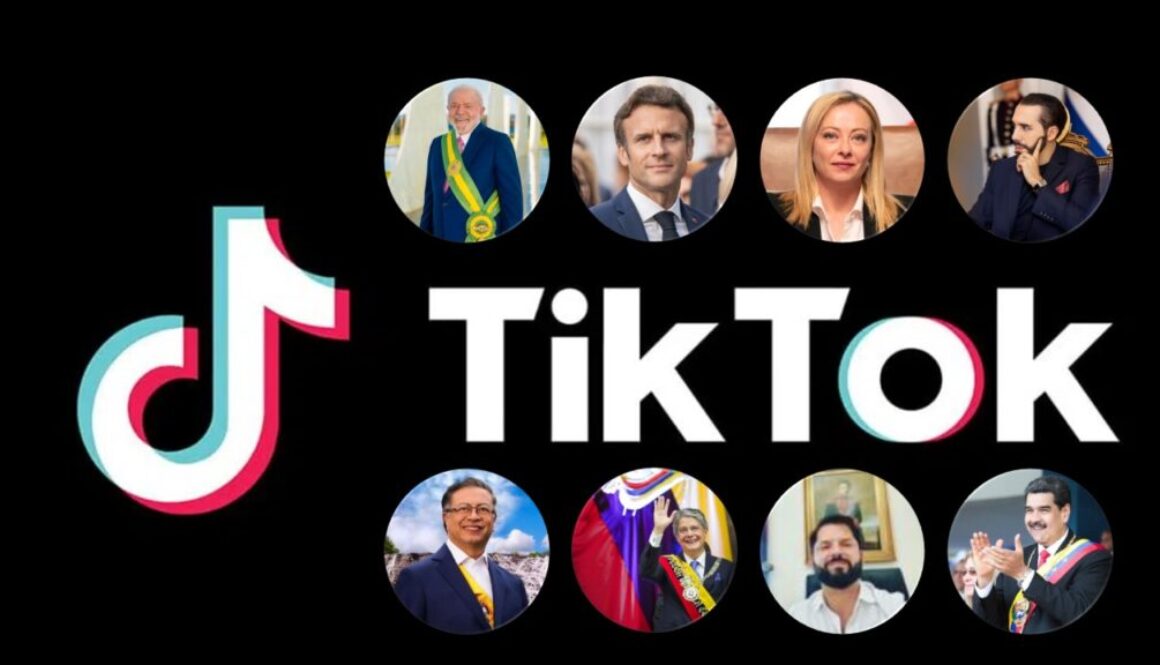
Brazil’s President Luiz Inácio Lula da Silva is in second place with 4.3 million followers and French President Emmanuel Macron is in third place with 3.9 million followers on the platform. Four other Latin American presidents make the Top 10 list, namely Colombia’s Gustavo Petro, Ecuador’s Guillermo Lasso, Venezuela’s Nicolás Maduro and Chile’s Gabriel Boric.
Bong Bong Marcos the President of the Philippines is the only Asian leader and Italy’s Giorgia Meloni is the only woman in the Top 10 TikTok ranking.
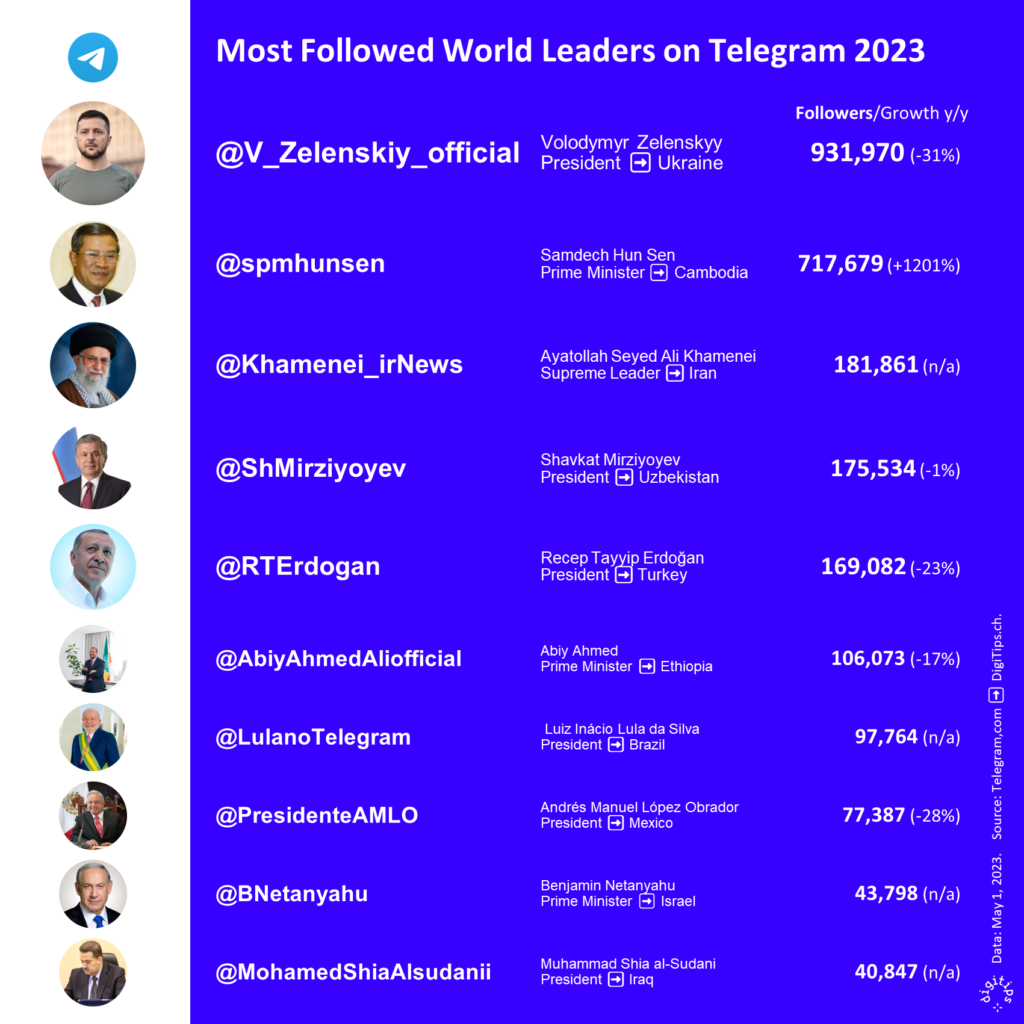
Ukrainian President is the most followed world leader on Telegram but he has lost a third of his follower since May 1, 2022. Many other world leaders in the top 10 have seen their numbers decrease significantly. The only newcomer in the ranking is Cambodia’s Prime Minister Hun Sen whose followers have grown tenfold to 717,679. He is closely followed by Iran’s spiritual leader Ayatollah Seyyed Ali Khamenei with 181,861 followers.
Heads of state and government and foreign ministers in only 50 countries have set up channels on Telegram which is particularly popular in the countries of the former Soviet Union.
As Twitter is morphing into a subscription-based network under its new owner Elon Musk, governments have started to look for other options. Brazilian President Luiz Inácio Lula da Silva, the Nigerian government and the Indian government have set up accounts on Koo, an Indian social media platform. The European Commission and the European External Action Service have created accounts on Mastodon. But so far, no current world leaders are on Bluesky, a social media platform funded by Twitter founder Jack Dorsey which is in private beta and has publicly refused to onboard high-profile government accounts.
Several hundred governments, world leaders and international organisations have lost their verification as Twitter pulled the plug on legacy blue check marks on April 20, 2023. Some 420,000 legacy verified Twitter accounts were demoted on the platform including over 300 accounts of heads of state and government, foreign ministers, and their institutions as well as 40 leading international organizations and their leaders.
Among the leaders and institutions who lost their verification are Pope Francis (@Pontifex), German Chancellor @OlafScholz, Dutch Prime Minister @MarkRutte, the UK @CabinetOfficeUK, Pakistan’s Foreign Minister @BBhuttoZardari, ECB President Christine @Lagarde, NATO Secretary General @JensStoltenberg and international organisations such as the @_AfricanUnion, the @ArabLeague_GS, the @ICRC & @IFRC, the @WEF and @WWF to name but a few. Over the weekend some of these accounts were granted either grey badges, gold badges or blue badges indicating they had subscribed to Twitter Blue. However the overall sentiment was one of chaos in the new system.
Over the past weeks Twitter had converted the old blue check marks into grey check marks for selected governments, multilateral organizations, and officials. However, it seems many governments and important international organisations have been left out.
Among the 1,160 Twitter accounts of heads of state and government and foreign ministers we track at @DigiTips only 684 are verified and among these only 374 have been switched to the grey badge which is free of charge.
In total seven royal accounts, 40 presidential accounts, 106 governmental accounts, 136 foreign ministries and foreign ministers and 79 international organisations and their leaders lost their precious blue tick. And 470 accounts of world leaders are still not verified.
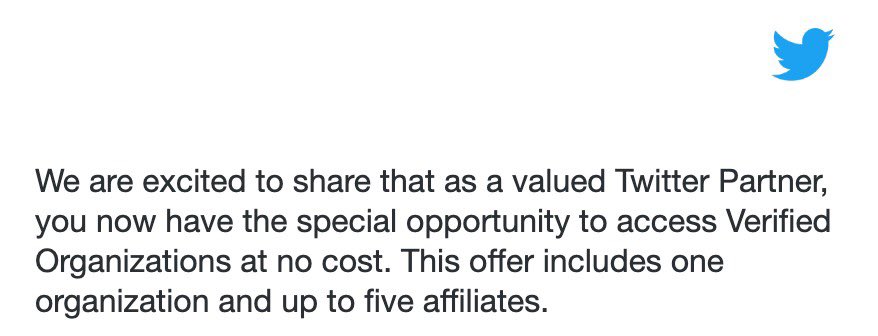
In a message to partners Twitter has offered free verification including five affiliate accounts, however it is unclear whether this offer has been extended to governments and international organizations.
The US State Department is so far the only foreign ministry which has opted for the affiliate verification system, verifying all its 377 embassies and ambassadors. El Salvador’s President Nayib Bukele is the first world leader to have created an affiliate verification.
Giving the difficulties to obtain verification over the past years, a handful of African leaders have recently subscribed to @TwitterBlue including the President of Congo, Denis Sassou-Nguesso, and Sylvie Baïpo-Temon, the foreign minister of the DRC.
There is a lot of confusion around the new verification system and which organizations can be verified. Governments and multilateral organisations can apply for the free grey badge, but it seems not everyone did so, or their applications haven’t been processed yet. It seems the grey badge does not come with the perks from a Twitter blue subscription such as longer tweets, longer videos and priority ranking in replies are not included.
Twitter verification is essential, especially for official governmental accounts to avoid impersonation and the spread of fake news.
After having angered key advertisers, antagonized media organisations and journalists Elon Musk is on a collision course with world leaders and international organisations who have relied on Twitter for more than a decade to reach their citizens.
Elon Musk does not seem to be afraid of any governments or leaders complaining. As he said on a recent interview with Fox TV: “I think people are a little concerned about complaining to me directly in case I tweet about it.”
So far world leaders have been mum about the changes on the platform and few have publicly mentioned him on Twitter with one notable exception: the Russian Foreign Ministry had some suggestions for the Twitter logo.
For lists of governmental accounts check out the DigiTips Twitter Lists. [The has been updated on April 23 to include the outcome of the Twitter cull]
The heads of state, governments and foreign ministers and ministries in 58 countries have an official presence on TikTok and quite a few are still active on TikTok despite a creeping public sector ban of the Chinese-owned platform in a growing number of Western capitals. The leaders of France, Ireland and Israel are still active on the popular social media platform which is also widely used for governmental communications in South America where almost all leaders have a channel on the platform.
Creeping Public Sector Ban
TikTok has been banned from government devices in Canada, the US, the UK, the European Union and a-growing list of European countries. The Czech government promptly deleted its TikTok channel @strakovka which had a respectable 14’800 followers and accumulated 69’600 likes on its 17 videos. Latvian Foreign Minister Edgars Rinkēvičs announced on Twitter that he had deleted his profile @EdgarsRinkevics which had 680 followers. “For security reasons, I have deleted my Tiktok account, @arlietas [the Foreign Ministry] prohibits the use of this application on smart devices that have ministry emails installed” he tweeted.
In Europe the app is slowly disappearing from government phones: the EU Commission deleted its account shortly after banning TikTok from the devices of its 32,000 permanent and contract employees. The TikTok channel of the @EuropeanCommission had never been active and had less than 50 followers.
Despite the ban, the @10DowningStreet channel set up under former Prime Minister Boris Johnson in May 2022 is still available and now boasts more than 280,000 followers. However Downing Street hasn’t been active since the end of July 2022 and the last video is a short clip with Larry, the Downing Street cat predicting an England win against Germany in the final of the Women’s Euro in 2022. Neither Liz Truss, nor Rishi Sunak have ever used the official TikTok account, and it is unclear whether it is still hosted on a governmental device and when and whether it will be deleted.
On the other hand, the TikTok account of theSecretary of State for Energy Security and Net Zero, Grant Shapps is active on the platform. In a reaction to the TikTok ban he posted a clip from the film The Wolf on Wall Street in which Leonard Di Caprio’s character claims: “You know, I am not leaving… I am not leaving.” Grant Shapps wrote in the caption: “I’ve never used TikTok on government devices and can hereby confirm I will NOT be leaving TikTok anytime soon!”
TikTok for Government Communications
In Paris and Dublin, where TikTok is part and parcel of both governments’ social media toolkit leaders are somewhat reluctant to impose a TikTok ban. The French government tweeted a statement from State Secretary for Europe, Laurence Boone that: “The crucial point in the #TikTok case is that European data must remain in Europe. The Irish and French data watchdogs are currently conducting an inquiry to ensure the platform is fully compliant with this rule.” In France TikTok was banned from work phones of civil servants along with other “recreational apps” such as Candy Crush and Netflix.
However, French President Emmanuel Macron continues to engage with his 3.9 million followers on the platform. The French government maintains an official account @GouvernementFR and a bespoke @Republique_gouv channel to fight delinquency and radicalisation. The Minister of the Economy, Bruno Le Maire and the Ministry of Education both have active channels on the platform. An outright TikTok ban would simply deprive the government of a powerful channel to reach a younger audience.
Irish President Michael Higgins was the first world leader to set up a TikTok channel on 29 July 2019. The @PresidentIRL channel is still active and recently shared a 10-minute excerpt from his St. Patrick Day’s address. In Dublin, where TikTok has its EU headquarters, the government @MerrionStreet, the Tánaiste (Foreign Minister) @MichealMartinTD and the Department of Further and Higher Education all have an active presence on the platform. The government’s most recent video is showing Taoiseach (Prime Minister) Leo Varadkar celebrating the Hindu festival of Holi. In his most recent video Foreign Minister Micheal Martin’s is reading an excerpt from the Gruffalo to encourage viewers to “squeeze in a read”.
TikTok worldwide
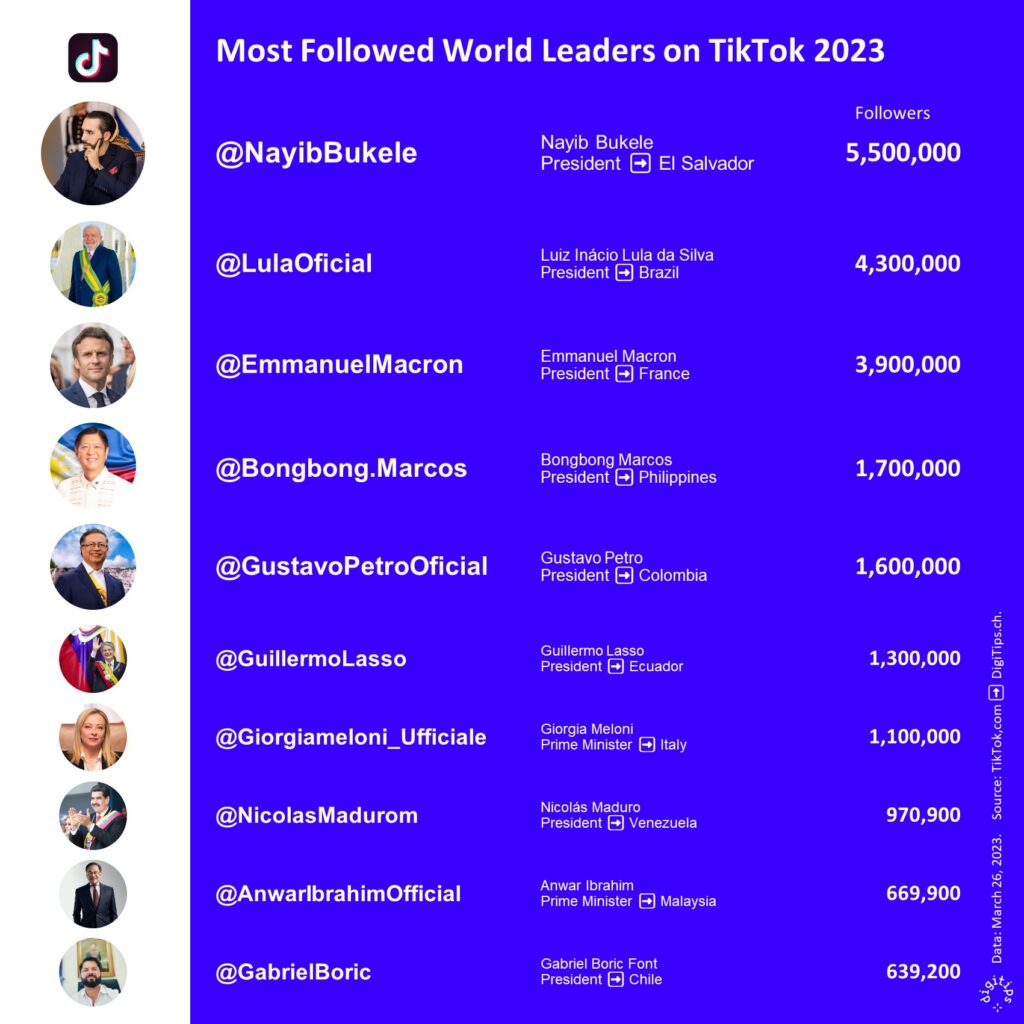
TikTok is widely popular among Latin American leaders and most presidents and governments have an official channel on the platform. El Salvador’s president Nayib Bukele has become the most followed world leader on TikTok. With his 5.5 million followers he is reaching a large Spanish speaking audience far beyond the 6.3 million population of his country. Showcasing his #GuerraContraPandillas (#FightAgainstGangs), his team has started to subtitle his videos in English for a global audience.
Top 10 List of the most followed heads of State and Government on TikTok (as of March 2023)
Brazil’s President Luiz Inácio Lula da Silva is in second place with 4.3 million followers and French President Emmanuel Macron is in third place of the most followed leaders on the platform. Four other Latin American presidents make the Top 10 list, namely Colombia’s Gustavo Petro, Ecuador’s Guillermo Lasso, Venezuela’s Nicolás Maduro and Chile’s Gabriel Boric.
Bong Bong Marcos the President of the Philippines is the only Asian leader and Italy’s Giorgia Meloni is the only woman in the Top 10 TikTok ranking. The Italian Prime Minister used TikTok effectively during her election campaign sharing videos and snippets from her campaign trail and she has 1.1 million followers after only a year on the platform.
TikTok Diplomacy
As of March 26, 2023, 40 heads of state and government had an active presence on the platform. However, there’s hardly any interaction between world leaders on TikTok which is mainly used to reach a national audience.
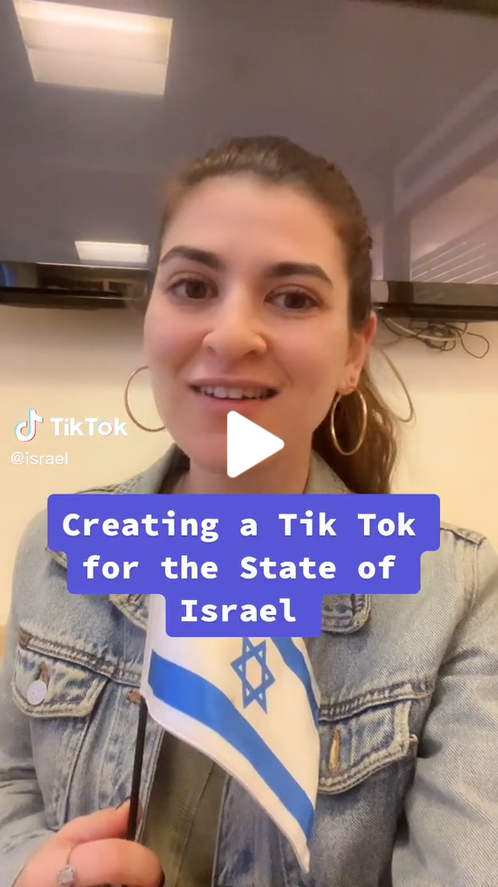
Only eight foreign ministries (Belarus, Colombia, Cuba, Israel, Mexico, Russia, Somalia, and Thailand) and six foreign ministers (Colombia, Ireland, Mexico, Panama, North Macedonia, and Togo) maintain TikTok channels, and few are active on the platform. The Israeli Foreign Ministry has made the best use of TikTok with three separate channels in Arabic, English, and Spanish totalling 609,000 followers and garnering 4.8 million likes.
Tamar Schwarzbard of the Israeli Foreign Ministry creating a TikTok
The Foreign Ministry has set up a dedicated team who produce videos about Israeli culture, customs, and cuisine, promoting Israel to foreign audiences. No other government has used TikTok to build bridges across borders and cultural divides as Israel has done. No other social media platform is as suited for two-way communications as TikTok. Beyond the comments and likes users can remix, reply and even duet – a TikTok video reply – helping spread the original content to their followers and beyond.
A full ban of TikTok would be counterproductive since governments would no longer be able to reach their key national audiences. If the public sector ban is purely for security concerns, governments and leaders would be well advised to use ‘burner phones’ for their social media activities, phones which are not connected to their internal networks or email servers. As there has been no indication that the Chinese government has ever used TikTok to spy on its international users, it seems the partial ban of TikTok is mainly driven by geopolitical considerations. TikTok is not only one of the most popular apps, but also the only major app which is not Made in the USA, which seems to be the main reason for a likely ban in the US. However, it will be difficult and even impossible for governments with a strong TikTok audience to endorse a ban of the app. As Sara Morrison put it in Vox: Is TikTok too big to ban?
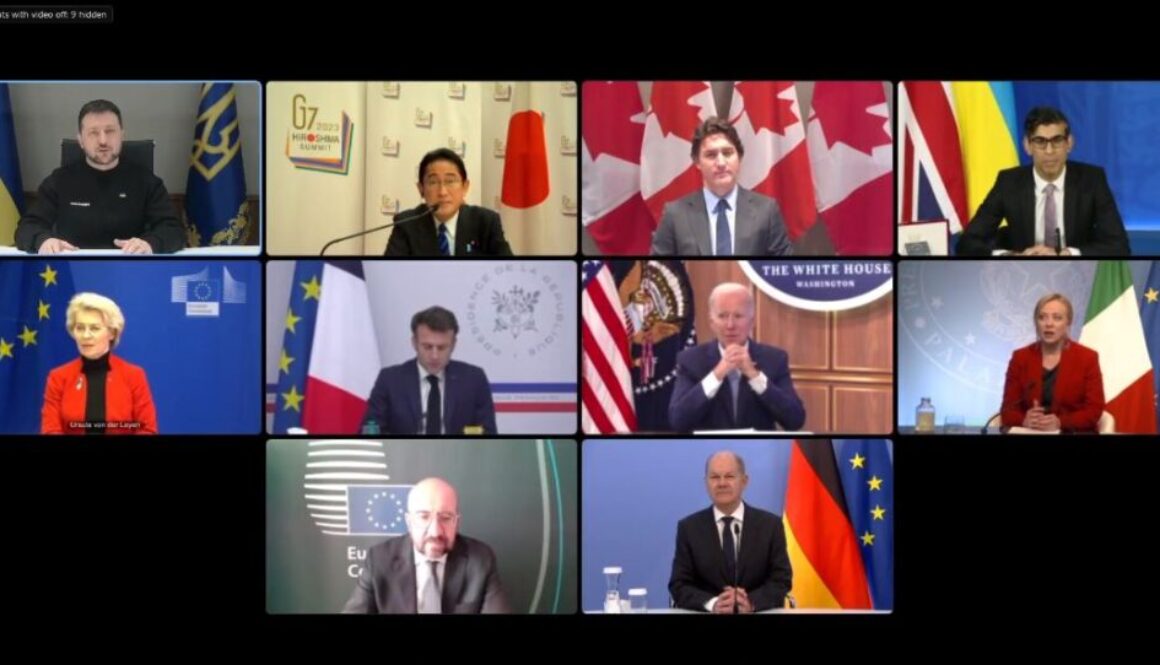
Ukrainian President Volodymyr Zelenskyy addressed the virtual meeting of G7 leaders on the one-year anniversary of Russia’s attack against Ukraine pleading for continued support in the fight for his country.
Canada’s @JustinpjTrudeau – although an outspoken supporter of Ukraine, German @Bundeskanzler Olaf Scholz and most surprisingly – @POTUS@JoeBiden do not follow the Ukrainian President despite being unilaterally followed by Volodymyr Zelenskyy who has 17 million followers on the platform. Zelenskyy does not yet have any digital relation with Japanese Prime Minister @Fumio_Kishida who holds the G7 presidency. The two men are not yet mutually connected on Instagram.
On Facebook the Ukrainian President follows 36 other pages including @JustinPJTrudeau who hasn’t returned the favour yet. Good digital relations on social are a sign of respect and close cooperation. While Zelenskyy is consistenly mentioning other world leaders in tweets, he would be well advised to follow his peers on social media to show the close digital cooperation.